
AI Content Not Engaging? Here’s How to Fix It for a UK Audience
🎯 Key Takeaway
Your AI content is not engaging because it lacks a distinct brand voice, emotional resonance, and strategic context, causing it to sound robotic and generic. The solution involves a structured human editing process focused on personality, storytelling, and localisation.
• AI content often fails due to a lack of strategic direction, resulting in isolated posts with no clear purpose.
• Generic Artificial Intelligence (AI) output misses crucial UK cultural nuances, humour, and spelling, creating a disconnect with your audience.
• Implementing a ‘Humanisation Framework’ to edit for voice, emotion, and accuracy is the fastest way to improve engagement.This guide provides an actionable checklist for UK Small and Medium-sized Enterprises (SMEs) to fix their AI content and move towards a fully automated, strategic approach.
You spend hours prompting, generating, and scheduling posts, only to be met with silence. No likes, no comments, no shares. It’s a common frustration, and many assume the algorithm is to blame. When your AI content not engaging, the problem isn’t the platform; it’s the content itself. Generic AI output, devoid of personality and cultural context, simply doesn’t connect, especially with a discerning UK audience. This is one of the biggest reasons why AI content fails. This article provides our practical ‘Humanisation Framework’ to fix it, and shows you how to move beyond manual tweaks to a powerful, strategic autopilot system for your social media.
Written by: Content Team | Reviewed by: Editorial Team, Industry Specialists
Last updated: 22 March 2026
ℹ️ Transparency Disclosure: This article explores why AI-generated content can lack engagement and provides solutions based on industry best practices and our own platform data. Some links may connect to our services. All information is verified by our editorial team. Social Media HQ is a division of Up-Stride.
Why is Your AI Content Not Engaging (And It’s Not the Algorithm)?
The fundamental reason your AI content not engaging is that it lacks a human touch. Unedited AI output is a collection of data patterns, not a piece of communication crafted with intent and personality. This manifests in four distinct ways.

First is the lack of a brand voice. AI defaults to a neutral, formal tone that strips your brand of its unique personality. It can’t instinctively be witty, empathetic, or authoritative like a human can. Second, there’s a significant emotion deficit. Research from Stanford University’s Human-Centered AI (HAI) (2024) highlights that while AI models are technically proficient, creating nuanced and emotionally resonant content remains a major hurdle. AI struggles to tell compelling stories or tap into the pain points that make customers feel seen and understood.
Third, the content is riddled with generic language and AI ‘tells’. Phrases like ‘In the digital age’, ‘unlock the potential of’, and ‘a testament to’ are dead giveaways that a robot wrote your copy. Finally, there’s the UK localisation gap. Standard AI models often miss the subtleties of British humour, idioms, and cultural references. They use American spellings (‘organize’, ‘color’) that instantly feel foreign to a UK reader. This is a common oversight for time-poor businesses; a report from the Federation of Small Businesses (FSB) (2022) found that a lack of time is a primary barrier for 25% of SMEs in adopting new technology, which explains why these crucial editing steps are often skipped. This is a key reason why AI content fails.
The 5-Minute ‘Humanisation’ Framework: Your Actionable Fix for Improving AI Generated Content
The fastest way to fix sterile AI content is to apply a quick, structured editing process. Our ‘Humanisation Framework’ is a five-step checklist designed to inject personality and relevance into any piece of AI-generated text in minutes. Think of it as the essential quality control check before you hit ‘publish’. Following this process is one of the most effective methods for how to make AI content more engaging.

Step 1: Inject Your Brand Voice
Before editing, define your brand with 3-5 core adjectives (e.g., ’empowering’, ‘witty’, ‘dependable’). Read the AI text aloud. Does it sound like your brand? If your voice is ‘witty’ but the text is ‘formal’, rewrite sentences to add personality. Swap generic verbs for more dynamic ones and ensure the tone matches the brand identity you want to project. This is the first step in improving AI generated content.
Step 2: Weave in Emotion & Story
AI generates facts; humans connect with feelings. Find a generic statement in the text and replace it with a small, relatable anecdote or an empathetic question. Instead of “Our software improves efficiency,” try “Tired of spending your evenings catching up on admin? We get it.” This simple shift addresses a customer’s feeling directly, creating an instant connection that AI alone cannot replicate.
Step 3: Localise for Britain
This step is non-negotiable for a UK audience. Run a quick check for Americanisms and correct them. This includes spelling (colour, organisation, analyse), terminology (change ‘vacation’ to ‘holiday’), and cultural references. A quick mention of ‘a proper brew’ or a shared grumble about the British weather can make your brand feel instantly more familiar and trustworthy.
| Generic AI Trait | Humanised Alternative | Impact on UK Audience |
|---|---|---|
| “In the digital age…” | “Let’s be honest, social media can feel like a chore.” | Relatable, direct, and acknowledges a shared frustration. |
| US Spelling: “Organize your workflow.” | UK Spelling: “Organise your workflow.” | Shows attention to detail and respect for the local audience. |
| Neutral Tone: “This product is effective.” | Emotional Hook: “Imagine getting 5 hours back every week. What would you do?” | Engages the reader’s imagination and connects to a tangible benefit. |
| Vague Claim: “We help businesses succeed.” | Specific Proof: “We helped a UK firm save 15+ hours weekly.” | Builds credibility and provides a concrete, believable result. |
Step 4: Purge AI ‘Tells’
You’ll quickly learn to spot the robotic phrases AI models love to use. Create a ‘banned words’ list for your brand. Common culprits include: ‘explore’, ‘use’, ”, ‘significant improvement’, and ‘handle the complex landscape’. Deleting these and replacing them with simpler, more direct language will instantly make your content sound more human and authentic.
Step 5: Fortify with Facts & Authority
Finally, elevate the content’s credibility. AI often makes vague claims. Your job is to replace them with specific, verifiable proof. Add a statistic from a reputable source, link to one of your case studies, or quote an industry expert. This not only makes the content more valuable but also positions your brand as a knowledgeable authority in its field.
How Do You Optimise AI Content for the UK Market?
You must tailor your humanised AI content to the specific platform you’re using, because engagement rules are not one-size-fits-all. A post that performs well on LinkedIn could easily fall flat on Instagram. Understanding the context of each platform is crucial for addressing AI social media content issues and boosting AI content engagement.
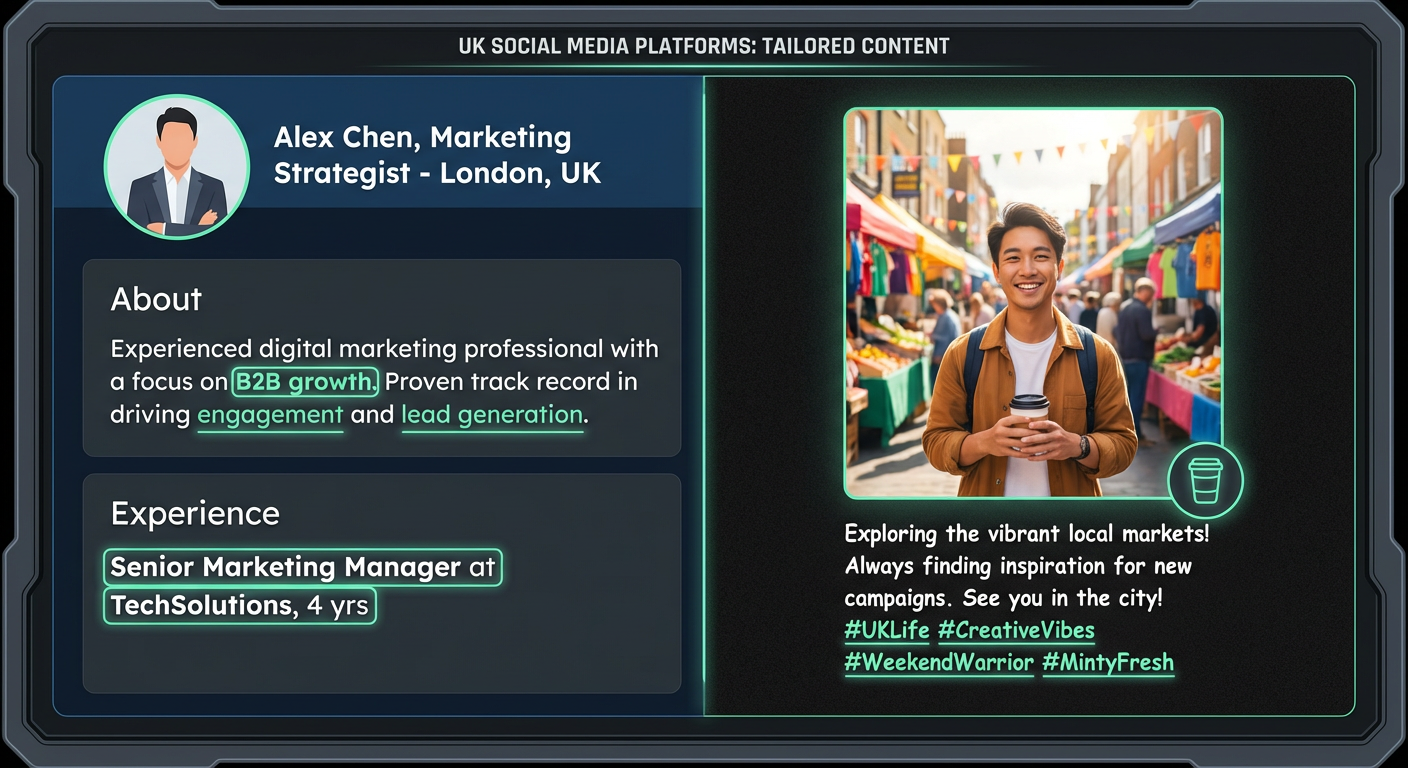
For a UK Small or Medium-sized Enterprise (SME), the contrast between LinkedIn and Instagram is particularly important. According to ongoing survey data from the Pew Research Center, different platforms attract distinct demographic groups. For LinkedIn, the audience is professional, so your content should reflect that. Here, you should humanise AI content by adding professional insights, relevant industry data, or thought-provoking questions that spark debate among peers. A generic AI post about ‘business growth’ becomes engaging when you add, ‘We’ve seen a 30% rise in demand from UK manufacturing firms this quarter. Are others in the sector seeing the same trend?’
Instagram, on the other hand, is a visual and personality-driven platform. The same AI-generated idea needs a different treatment. Here, focus on injecting personality, humour, and visually descriptive language into your captions. A photo of your team could be captioned by an AI with “Our team is dedicated to success.” The humanised version might be, “Fuelled by a frankly heroic amount of tea and biscuits, the team smashed our Q1 target today. So proud of this lot!” This approach feels authentic and builds community. With social media ad spending in the UK projected to exceed £10 billion by Statista, optimising content for each platform isn’t just good practice – it’s a financial necessity.
How Do You Go From Manual Fixes to Autopilot?
The solution isn’t just about fixing individual posts; it’s about fixing the entire process, because the core problem when your AI content not engaging is a lack of strategy. The ‘Humanisation Framework’ is an effective tactical fix, but manually editing every single post isn’t a scalable solution. The real strategic leap is moving from generating isolated posts to managing a coherent, automated content strategy. This aligns with the UK’s national goals; the government’s National AI Strategy paper outlines a plan to support the transition to an AI-enabled economy by encouraging adoption across all sectors.
This is where we built Social Media HQ by Up-Stride to be different. Our platform isn’t just a text generator; it’s a fully automated social media system that handles your entire strategy. It operates on our proprietary Auto-Run system, a 3-step process:
- Setup & Brand Alignment: We create a locked brand profile that learns your unique voice, target audience, and business goals.
- Campaign Creation & Auto-Run: The AI then generates entire, multi-post campaigns that are strategically linked, localised for the UK, and aligned with your brand.
- AI Learning & Optimisation: The system analyses performance and gets smarter every week, continuously improving results without any ongoing effort from you.
By automating the strategy, not just the text, our system ensures every post has a purpose. It’s the difference between a robot handing you random sentences and a strategic partner building your brand presence while you focus on your business. This is how you achieve consistently high AI content engagement at scale.
Important Considerations
It’s important to acknowledge the limitations of this advice. The ‘Humanisation Framework’ requires manual effort and a degree of creative judgment. Generative AI is a tool, not a strategist; it cannot understand your business goals or the subtle emotional triggers of your customers without explicit, detailed guidance. The effectiveness of these techniques also depends on the quality of the underlying AI model and the prompts used.
There are two main alternatives to using and editing basic AI content. The first is to hire a professional human copywriter or social media manager, which offers the highest quality of creativity and strategic thinking but comes at a significant cost. The second is to use a more advanced, strategic AI platform like Social Media HQ that moves beyond single-post generation to manage entire campaigns, learn your brand voice, and automate content within a strategic framework.
If you consistently struggle to create engaging content despite these tips, or if you lack the time for manual social media management, it may be time to consult an expert or explore a strategic automation solution. A system designed to manage strategy, not just text, can provide the consistency and quality needed for growth without the manual overhead.
Frequently Asked Questions
Why is my AI content not engaging?
The primary reason your AI content is not engaging is its lack of a unique brand voice, emotional depth, and strategic purpose. AI models are trained on vast, generic data, causing them to produce content that feels robotic and disconnected from your specific audience. To fix this, you must manually edit for personality, storytelling, and brand alignment. This ensures the content resonates on a human level rather than just filling a space on a feed.
What is the 3 3 3 rule in marketing?
The 3-3-3 rule is a guideline for capturing attention, stating you have 3 seconds to grab attention, 30 seconds to engage, and 3 minutes to convert. While a useful concept, its rigid timeframes are less important than the core principle: your content must have an immediate hook. For AI content, this means the first sentence must be compelling and human-sounding, not a generic AI-generated opening that is associated with users to scroll past.
What is the 5 5 5 rule on social media?
The 5-5-5 rule is a community engagement strategy suggesting that for every 15 actions, you share 5 pieces of others’ content, comment on 5 posts, and create 5 of your own. It’s about being a participant, not just a broadcaster. This rule highlights a key failure of basic AI automation: it often focuses only on broadcasting, ignoring the crucial engagement part of the social media equation, which is why it’s a poor long-term strategy.
What are the 5 C’s of content?
The 5 C’s of content are: Clear, Concise, Compelling, Credible, and Consistent. This framework serves as an excellent checklist when humanising AI-generated text. Is the message clear and easy to understand? Is it compelling enough to stop the scroll? Is it credible with facts or authority? And does it align consistently with your brand voice? Using these as editing pillars helps transform generic AI output into effective, engaging communication.
Why is no one liking my posts anymore?
If engagement has dropped, it’s often because your content has become too generic, repetitive, or fails to provide real value. Over-reliance on unedited AI can accelerate this decline, as the output may lack the novelty and personality that builds a loyal audience. Low engagement is a clear signal to refresh your content strategy, analyse what your audience truly wants, and inject more human creativity and value into every post.
How do I make my content more engaging?
To make content more engaging, focus on three things: personality, value, and interaction. Inject your unique brand voice, use storytelling, and don’t be afraid of appropriate humour. Ensure every post offers tangible value – a tip, a new perspective, or a useful resource. Finally, typically end with a question or a clear call to action to encourage comments and shares. This is a great way of how to make AI content more engaging.
What is the 5-3-1 rule on Instagram?
The 5-3-1 rule is an engagement ratio suggesting that for every 1 promotional post, you share 3 non-promotional pieces of content and engage with 5 other accounts. Like similar rules, it emphasizes the importance of community interaction over constant self-promotion. A successful social media strategy, whether manual or automated, must balance broadcasting your message with genuine participation in the wider community to build trust and relationships.
What is the 3 second rule on Instagram?
The 3-second rule on Instagram refers to the belief that you have only three seconds to capture a user’s attention as they scroll. This makes your visual content and the first line of your caption strongly critical. Your opening hook must be powerful enough to stop the scroll and persuade the user to invest more time in your post. This is precisely where generic, robotic AI-generated opening sentences most often fail to perform.
What is the 24 hour rule on Instagram?
The ’24-hour rule’ on Instagram primarily relates to Stories, which create urgency by disappearing after 24 hours. However, it also applies to post engagement, as the algorithm tends to favour posts that generate significant interaction (likes, comments, shares) within the first few hours. Promptly replying to all comments can help fuel this crucial initial momentum and increase your post’s overall visibility on the platform.
Is 200 followers low?
Whether 200 followers is ‘low’ depends entirely on your business goals and engagement rate. For a local UK business, 200 highly engaged local customers can be far more valuable than 2,000 unengaged followers from around the world. We advise clients to focus on the quality and engagement of their followers rather than the raw number. A small, dedicated community that trusts your brand is a powerful asset.
Make Your AI a Partner, Not a Generic Robot
The core reason your AI content not engaging is a human-shaped hole at its centre. By implementing a simple ‘Humanisation Framework’ to inject brand voice, emotion, and localisation, you can transform robotic output into posts that truly connect. However, moving beyond single-post fixes for improving AI generated content to a strategic, automated system like our Auto-Run process is the key to unlocking scalable growth and reclaiming valuable time.
Stop fighting with generic content and let a smarter AI do the heavy lifting. Social Media HQ is a fully automated social media system designed for UK SMEs that manages your entire strategy, from brand-aligned content creation to campaign execution. It’s set up once, then let it run forever. Start your free 7-day trial today and get live in under 24 hours.
References
- Federation of Small Businesses (FSB) – 2022 Report. Found that 25% of UK small businesses find adopting new technology challenging due to a lack of time and resources.
- Stanford University Human-Centered AI (HAI) – 2024 Annual Report. Notes that while AI models show increasing technical proficiency, creating nuanced, emotionally resonant, and contextually appropriate content remains a significant challenge.
- UK Government – National Strategy Paper. Outlines a 10-year plan to support the transition to an AI-enabled economy, encouraging AI adoption across all sectors, including SMEs.
- Pew Research Center – Ongoing Survey Data. Provides demographic data on social media platform usage, showing different age groups and populations prefer platforms like Instagram versus LinkedIn.
- Statista – Market Forecast Data. Projects social media advertising spending in the United Kingdom to reach over £10 billion, highlighting the financial importance of effective content.
- The Sheffield Marketing Co. – 2024 Article. Suggests that a drop in engagement is often due to content not resonating with the audience, rather than just algorithm changes.
- LSM – 2024 Blog Post. Lists inconsistency and overly promotional content as key reasons for suffering social media engagement.
- LinkedIn Pulse – 2024 Article. Argues that lack of a clear value proposition is a primary driver of zero engagement on social media posts.
CONCLUSION
Make Your AI a Partner, Not a Generic Robot
In summary, AI content not engaging is a direct result of a human-shaped hole at its centre; it lacks the unique voice, emotional resonance, and local context that builds trust with a UK audience. By implementing a simple ‘Humanisation Framework’ to inject brand personality, storytelling, and British nuances, you can begin the process of improving AI generated content. However, the ultimate solution lies in moving beyond single-post fixes to a strategic, automated system. This is the key to unlocking scalable growth and reclaiming your valuable time.
Stop fighting with generic content and let a smarter AI do the heavy lifting. Social Media HQ is a fully automated social media system designed for UK SMEs that manages your entire strategy, from brand-