
AI Ethics in Social Media: A Comprehensive Guide for Responsible UK Leaders
🎯 Key Takeaway
Implementing robust AI ethics in social media requires UK business leaders to proactively manage risks like algorithmic bias and data privacy while adhering to principles of transparency, fairness, and accountability. This approach not only ensures compliance but also builds significant brand trust and loyalty.
• Key ethical risks include algorithmic bias, data privacy violations, and the spread of misinformation, which can damage brand reputation.
• UK leaders must navigate guidance from the Information Commissioner’s Office (ICO) and the Advertising Standards Authority (ASA).
• A practical framework based on transparency, accountability, and fairness allows Small and Medium-sized Enterprises (SMEs) to innovate responsibly and gain a competitive edge.This guide provides an actionable checklist for integrating these principles into your social media strategy.
The rapid adoption of Artificial Intelligence (AI) in social media is undeniable. With UK social media advertising spend projected to surpass £10 billion, businesses are increasingly turning to AI to gain an edge. According to a 2025 report from the Stanford University Human-Centered AI (HAI), investment in AI for marketing and sales automation continues to rise sharply. However, this power comes with responsibility. For UK leaders, the conversation around AI ethics in social media is paramount. Falling into ethical traps like algorithmic bias or data misuse can cause irreparable brand damage.
We firmly believe that a strong ethical foundation isn’t a barrier to innovation; it’s a strategic advantage. For UK SMEs, mastering ethical AI marketing uk builds trust and sets you apart. This guide will help you understand the core risks, handle the UK’s evolving rules, and implement a practical framework for responsible growth. We’ll show you how to choose the right tools and partners to ensure your social media is not just effective, but also ethical.
Written by: Social Media HQ by Up-Stride | Reviewed by: Editorial Team, Industry Specialists
Last updated: 15 March 2026
ℹ️ Transparency Disclosure: This article explores AI ethics in social media based on our analysis of governmental reports, academic research, and industry best practices. Some links may connect to our services, such as Social Media HQ. All information is verified by our editorial team to ensure accuracy and relevance for UK business leaders. Social Media HQ is a division of Up-Stride.
What Are the Core Ethical Risks of Poor AI Ethics in Social Media?
Adopting AI without a clear ethical compass exposes your business to significant risks that can undermine customer trust and brand reputation. These aren’t abstract concepts; they have real-world consequences for how your brand is perceived. The primary challenges centre on fairness, privacy, and truthfulness. A 2025 survey by the Pew Research Center indicates that a majority of social media users are concerned about how companies use their personal data, making this a critical area for businesses to address. Poorly managed AI can quickly turn a powerful tool into a liability. Understanding these risks is the first step towards building a resilient and responsible social media presence.

Algorithmic Bias and Fairness
Algorithmic bias refers to AI systems producing prejudiced results that reflect and often amplify existing human biases. Because AI learns from data, if that data contains historical inequalities (for example, in hiring or lending), the AI will replicate them. This can lead to discriminatory ad targeting where certain demographics are unfairly excluded from opportunities, or content distribution that silences minority voices. It’s a major challenge that requires constant vigilance and auditing to ensure fair outcomes.
Data Privacy and User Consent
Data privacy is a cornerstone of ethical AI. AI models, especially in social media, are trained on vast datasets of user behaviour and personal information. The ethical and legal challenge is ensuring this data is collected and used with explicit consent, in line with the UK’s General Data Protection Regulation (GDPR) and the Data Protection Act 2018. Using data without proper consent isn’t just unethical; it’s illegal and can lead to severe penalties and a complete loss of customer trust.
Misinformation and AI-Generated Content
The ethics of AI content generation ethics are a hot topic. AI’s ability to create highly realistic text, images, and videos (including deepfakes) presents a significant risk of spreading misinformation. For a brand, accidentally or intentionally sharing AI-generated content that is misleading or false can erode public trust almost instantly. As these tools become more accessible, the responsibility to verify and label AI-generated content transparently becomes even more critical for maintaining brand integrity.
How Can You handle the UK’s AI Regulatory Landscape?
Navigating the UK’s approach to AI regulation is crucial for any business implementing ethical AI marketing uk. Unlike the EU’s prescriptive AI Act, the UK has adopted a ‘pro-innovation’, principles-based approach. This means there isn’t a single, all-encompassing ‘AI law’. Instead, the government expects existing regulators to apply their current legal frameworks to AI. This approach, detailed in the UK Government’s National AI Strategy, is designed to encourage adoption while ensuring safety.

For UK SMEs, this means you need to be aware of how key bodies like the Information Commissioner’s Office (ICO) and the Advertising Standards Authority (ASA) interpret their roles in the age of AI. The newly formed UK AI Safety Institute is primarily focussed on the risks of advanced, future AI systems, so for most businesses, the ICO and ASA are the most relevant regulators for UK AI regulations social media.
The Information Commissioner’s Office (ICO) and AI
The Information Commissioner’s Office (ICO), the UK’s independent data protection regulatory body, is at the forefront of AI governance. Its focus is on ensuring that any use of AI involving personal data adheres to established data protection principles: lawfulness, fairness, and transparency. The ICO’s guidance on AI explains that businesses must be able to justify their data processing activities, conduct Data Protection Impact Assessments (DPIAs) for high-risk AI projects, and explain AI-driven decisions to individuals. For social media, this means you must be transparent about how you use AI to target users or personalise content.
The Advertising Standards Authority (ASA) and AI
The Advertising Standards Authority (ASA) governs advertising standards in the UK and has turned its attention to AI. Its rules require that advertising must be responsible and not misleading. For AI, this is particularly relevant for AI-generated imagery. The ASA requires marketers to disclose when an image of a person has been created or significantly altered by AI, especially if it could materially mislead the consumer. For example, using a completely AI-generated “customer” testimonial image without disclosure would likely breach ASA rules on truthfulness.
A Practical Framework for Responsible AI in Social Media
an effective way to implement responsible AI for social media is to adopt a structured, principles-based framework. This transforms abstract ethical ideas into concrete actions. For UK SMEs, who often feel challenged by a lack of time and resources as noted by the Federation of Small Businesses (FSB) (2023), a clear framework makes ethical compliance manageable and sustainable. It’s about building good habits into your workflow, not adding complex new burdens.
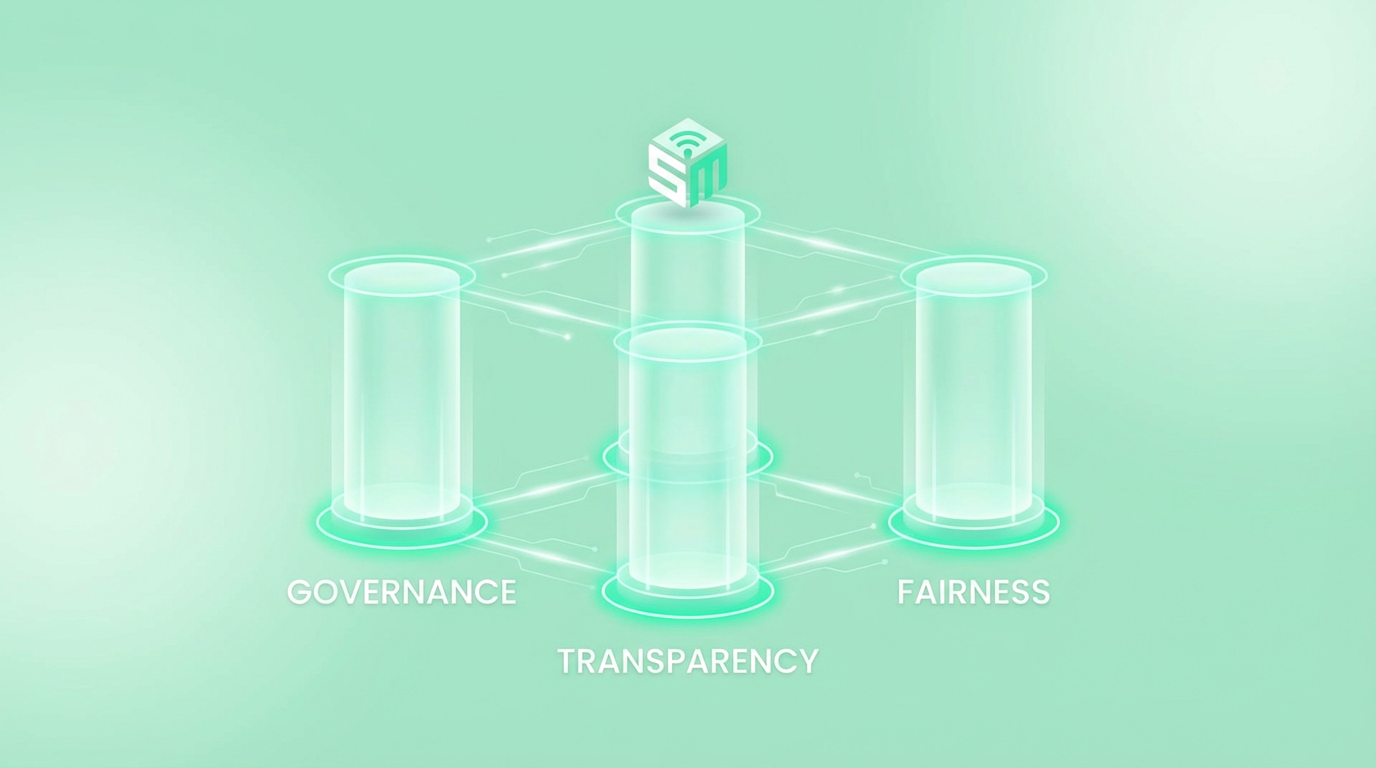
Our approach centres on three pillars: Governance, Transparency, and Fairness. By embedding these into your social media operations, you create a system that is not only compliant but also builds deep, lasting trust with your audience.
| Ethical Principle | Key Action for UK SMEs | Relevant UK Guidance | Practical Implementation |
|---|---|---|---|
| Accountability | Designate a person or team responsible for AI ethics oversight. | ICO Accountability Framework | Create a simple policy document outlining your AI use cases and the person responsible. |
| Transparency | Clearly disclose when AI is used for significant interactions (e.g., chatbots, generated images). | ASA Guidance on AI | Add a simple label like ‘AI Assistant’ to your chatbot or a note on AI-assisted images. |
| Fairness | Regularly review AI-driven campaign performance for signs of demographic bias. | ICO Guidance on AI and Data Protection | Check ad delivery stats across different audience segments to ensure equitable reach. |
| Data Privacy | Only use AI tools that are UK GDPR compliant and respect user consent. | Data Protection Act 2018 | Vet any third-party AI tool for its data privacy policy before integrating it. |
This structured approach helps demystify AI ethics in social media, turning it into a series of achievable steps. It’s about being intentional and proactive.
Case Study: How a UK firm saved 15+ hours weekly through AI
Challenge: Focus on immediate pain points of UK SME leaders: wasted time and rising operational costs. The ‘hidden cost’ of manual data entry in UK Professional Services.
Solution: Automated workflows and lead research/client management automation for professional services.
Results: saved 15+ hours weekly
Key Insight: AI automation can significantly reduce time spent on manual tasks, leading to substantial efficiency gains for professional services SMEs.
This demonstrates that automation, when applied ethically and strategically, delivers powerful results.
How Do You Choose an Ethical AI Partner for Your Social Media?
Choosing the right AI partner is the most critical step in implementing responsible AI for social media. The right tool should not only deliver results but also have ethical principles built into its DNA. When evaluating vendors, you need to ask tough questions that go beyond features and pricing. It’s about ensuring their technology aligns with your brand values and commitment to ethical practices.
Here are the key questions we believe every leader should ask a potential AI vendor:
- Data Sourcing: Where do you get the data to train your AI models? Is it sourced ethically and with consent?
- Bias Mitigation: What specific features do you have to detect and mitigate algorithmic bias in content creation and ad targeting?
- Transparency: Can you explain how your AI makes decisions? Is the process a “black box,” or is there clarity?
- User Control: How much control do I have over the final output? Can I review, edit, and approve everything before it goes live?
- Compliance: How does your platform ensure compliance with UK GDPR and ASA guidelines on
social media automation ethics?
At Social Media HQ, we’ve built our system around these principles. Our proprietary Auto-Run system is designed for both efficiency and ethical oversight. It’s a 3-step process: 1. Setup & Brand Alignment, 2. Campaign Creation & Auto-Run, and 3. AI Learning & Optimisation. The critical first step locks in your brand’s unique voice, values, and ethical guardrails. This means our AI doesn’t just create content; it creates content that is aligned with your standards.
Also, our platform operates on a “human-in-the-loop” model. You can review and approve every single post before it’s scheduled, ensuring you have the final say. This combination of smart automation and absolute user control is what makes a fully automated social media system like Social Media HQ a truly responsible choice. Our Auto-Run system allows your social media to be running on autopilot without sacrificing ethical integrity.
Important Considerations
The field of AI and its regulation is evolving at an unprecedented pace. The guidance and principles outlined in this article are based on the landscape as of Q1 2026. Business leaders should treat this as a foundational guide, not as definitive legal advice, and stay informed of updates from UK regulatory bodies.
While a fully automated system like Social Media HQ offers significant efficiency, it is one of several approaches. Alternatives include using individual generative AI tools (e.g., for copy or images) combined with manual scheduling, or hiring a specialised social media agency. Each approach carries different trade-offs in cost, time investment, and control over social media automation ethics.
For specific compliance questions related to your data processing activities or advertising claims, we strongly recommend consulting with a legal professional specialised in technology and data protection. The ICO’s official website also offers comprehensive documentation and contact points for businesses seeking formal guidance.
Frequently Asked Questions About AI Ethics in Social Media
What is AI ethics in social media?
AI ethics in social media is the framework of moral principles and techniques used to guide the development and use of artificial intelligence on social platforms, ensuring it operates fairly, transparently, and without causing harm. It addresses issues like bias, privacy, and accountability. This is critical for maintaining user trust and brand integrity in an increasingly automated world.
How can AI create bias in social media marketing?
AI can create bias by learning from historical data that contains existing societal prejudices, leading to discriminatory outcomes. For example, an ad campaign algorithm might disproportionately show job adverts for high-paying roles to one gender over another based on past data. Responsible AI practices involve actively monitoring for and correcting these biases to ensure fairness.
What are the main UK regulations for AI in social media?
The UK currently applies existing laws to AI rather than having one single ‘AI Act’, focusing on a pro-innovation stance. Key regulations include the UK GDPR and Data Protection Act 2018, enforced by the ICO, and advertising codes from the ASA. Businesses must ensure their use of AI on social media complies with these existing UK AI regulations social media frameworks.
Is it unethical to use AI for content generation?
Using AI for content generation is not inherently unethical, but its application determines its ethical standing. AI content generation ethics become a concern if it’s used to create deceptive content (deepfakes), spread misinformation, or infringe on copyright. Ethical use involves transparency and ensuring the final output is accurate, authentic, and clearly attributed if necessary.
How can I ensure my business is using AI transparently?
To use AI transparently, you should clearly disclose when it’s being used in significant ways that affect the user experience. For instance, label chatbots as ‘AI assistants’ and indicate when marketing images have been heavily modified by AI. Providing simple explanations of how AI influences the content users see also builds significant trust with your audience.
What is the role of the ICO in AI ethics?
The ICO’s role is to ensure that organisations using AI process personal data lawfully, fairly, and transparently. It provides guidance on data protection principles in an AI context, such as conducting impact assessments and explaining AI-driven decisions to individuals. It acts as the UK’s primary regulator for data privacy within AI systems, making its guidance essential.
Can small businesses afford to implement ethical AI practices?
Yes, implementing ethical AI is more about process and principle than expensive technology. Many foundational steps, like creating an accountability policy, being transparent with customers, or carefully reviewing AI-generated content, have no direct cost. Using responsible AI tools can also be more cost-effective in the long run by avoiding fines and reputational damage.
What should I look for in a responsible AI social media tool?
Look for a tool that offers user control, transparency in its operations, and features to mitigate bias. Key features include the ability to review and edit all AI-generated content before it goes live, clear explanations of how the AI works, and customisation options to align the AI’s output with your specific brand values and audience guidelines.
How does data privacy relate to AI ethics on social media?
Data privacy is a cornerstone of AI ethics because AI models are trained on vast amounts of data, often personal in nature. Ethically, this data must be sourced and used responsibly, with user consent and in compliance with regulations like the UK GDPR. Using data unethically for AI training is a major breach of trust and law.
What is the difference between AI ethics and AI safety?
AI ethics is a broad field concerning moral principles like fairness and bias, focusing on societal impact and responsible daily use. In contrast, AI safety is a more technical subfield focused on preventing advanced AI systems from causing unintended harm or behaving in catastrophic, unpredictable ways. For most businesses today, AI ethics is the more immediate concern.
Making Ethical AI Your Competitive Advantage
Embracing AI ethics in social media is no longer optional for forward-thinking UK businesses; it is a strategic imperative. By moving beyond the technology and focusing on the principles of accountability, transparency, and fairness, leaders can mitigate significant brand risk. This proactive stance transforms a potential compliance burden into a powerful tool for building lasting customer trust and a resilient brand reputation in a crowded digital marketplace.
For leaders who want to implement an ethical and efficient AI social media strategy without the complexity, a system designed with these principles at its core is essential. It’s about getting your brand live in under 24 hours with zero ongoing effort, while knowing that ethical guardrails are securely in place. The right system gets smarter every week, all while running on autopilot.
Learn how Social Media HQ builds brand-aligned campaigns on autopilot, giving you the power of AI with the assurance of human oversight.
References
- Federation of Small Businesses (FSB) – 2023 Report. This survey of UK small businesses found that 25% find adopting new technology challenging due to a lack of time and resources.
- Stanford University Human-Centered AI (HAI) – 2025 Annual Report. This comprehensive index tracks global AI adoption and investment, showing significant year-over-year growth in AI for marketing and sales automation.
- UK Government – National AI Strategy Paper. This document outlines the UK’s goal to be a ‘global AI superpower’ by encouraging AI adoption across all sectors, including SMEs.
- Pew Research Center – Social Media Fact Sheet (2025 data). This research provides data on social media usage, indicating that a majority of users are concerned about how companies use their personal data.
- Statista – Market Forecast Data. This forecast projects UK social media advertising spending will exceed £10 billion in the coming year, highlighting the scale of the market.
- AdMonsters – Industry analysis (2025). Highlights the urgency for addressing algorithmic bias and fairness in AI-driven social media advertising.
- Queen Mary University of London – Academic research blog. Discusses the societal implications of AI, including the role of ethics in maintaining a healthy information environment on social platforms.
- Novus – Industry blog (2025). Explores key ethical issues of AI in social media, such as the potential for increased user polarization.
Making Ethical AI Your Competitive Advantage
In summary, AI ethics in social media is no longer optional for forward-thinking UK businesses; it is a strategic imperative. By moving beyond the technology and focusing on the principles of accountability, transparency, and fairness, leaders can mitigate significant brand risk. This proactive stance transforms a potential compliance burden into a powerful tool for building lasting customer trust and a resilient brand reputation in a crowded digital marketplace.
For leaders who want to implement an ethical and efficient AI social media strategy without the complexity, a system designed with these principles at its core is essential. Learn how Social Media HQ builds brand-aligned campaigns on autopilot, giving you the power of AI with the assurance of human oversight.
Frequently Asked Questions About AI Ethics in Social Media
What is AI ethics in social media?
AI ethics in social media is the framework of moral principles and techniques used to guide the development and use of artificial intelligence on social platforms, ensuring it operates fairly, transparently, and without causing harm. It addresses issues like bias, privacy, and accountability. This is critical for maintaining user trust and brand integrity.
How can AI create bias in social media marketing?
AI can create bias by learning from historical data that contains existing societal prejudices, leading to discriminatory outcomes. For example, an ad campaign algorithm might disproportionately show job adverts for high-paying roles to one gender over another. Responsible AI practices involve actively monitoring for and correcting these biases.
###