Social Media HQ vs Buffer: An AI-First Comparison for UK SMEs
🎯 Key Takeaway
The choice in a social media hq vs buffer comparison boils down to your business goal: Buffer is a task-based scheduler for manual management, whilst Social Media HQ is an AI-driven system for automated content creation and growth. For Small and Medium-sized Enterprises (SMEs) seeking hands-off, strategic results, Social Media HQ is the superior alternative. We believe the key decision points are:
Task vs. Strategy: Buffer helps you organise and schedule content you create manually. Social Media HQ ideates, creates, and deploys entire campaigns for you.
Time Investment: Buffer requires ongoing manual input. Our Social Media HQ is designed to run on autopilot after an initial brand setup, saving significant weekly hours.
* Target User: Buffer suits marketers with content creation capacity. Social Media HQ is built for time-poor UK SME owners who need to delegate their entire social media function.
The constant demand for fresh, engaging social media content is a significant challenge for UK business owners. Resources are tight, and time is the most valuable commodity. As of March 2026, the discussion around the social media hq vs buffer choice isn’t just about features; it’s a strategic decision between two fundamentally different philosophies. Do you need a better tool to help you perform a manual task, or do you need an autonomous partner that delivers a business outcome?
This article provides a pragmatic comparison. We’ll analyse the core difference between assisted scheduling and true Artificial Intelligence (AI) automation, dive into key functionalities, and assess the real-world return on investment for an ambitious UK SME. For those asking ‘what’s better than buffer’, the answer depends on whether you want to manage a process or automate a result.
Written by: Social Media HQ (by Up-Stride) | Reviewed by: Editorial Team, Industry Specialists
ℹ️ Transparency Disclosure
Social Media HQ (by Up-Stride) is our product. This transparency disclosure indicates that whilst we are one of the products being compared, this analysis is grounded in publicly available data, user reviews from platforms like Capterra, and the specified functionality of both systems. Our goal is to provide a fair, authoritative comparison to empower you to make an effective decision for your business.
What is Social Media HQ? The AI System for Automated Growth
Social Media HQ is an autonomous marketing partner designed to manage your entire social media function. It moves beyond simple scheduling to provide a complete, AI-powered solution. Our platform represents a paradigm shift in AI social media management. The core idea isn’t to give you a better calendar, but to take the work of filling that calendar completely off your plate.

Our system uses an AI-driven process that starts by analysing your brand, website, and target audience. From there, it identifies relevant topics, generates engaging posts with text and images, and builds strategic campaigns. This approach aligns with the UK Government’s national strategy to encourage AI adoption to boost productivity across all sectors, including SMEs. To put it simply: Buffer is a calendar reminder to cook dinner; Social Media HQ is the chef who plans the menu, buys the ingredients, and cooks the meal for you. This is a critical distinction, as Stanford University’s AI Index Report (2024) notes the rapid integration of AI into tools that drive real economic activity.
What is Buffer? The Established Scheduler for Hands-On Marketers
Buffer is a highly regarded software application for social media scheduling, acting as a centralised content queue for your marketing efforts. Its primary function is to allow users to load pre-made content into a “buffer,” which then posts that content to various social networks at pre-determined times. It excels at organising and executing a manual workflow.

Its strengths are undeniable: a clean user interface, reliability, and simplicity make it a favourite for marketers who already have a content strategy and the resources to create posts. According to data from Capterra (2025), users frequently praise its ease of use for straightforward scheduling tasks. However, it’s crucial to understand that Buffer is a tool that facilitates a task; it doesn’t perform the task for you. It organises manual work, it doesn’t replace it. For businesses looking at what to use instead of Buffer because they lack the time for content creation, this distinction is everything.
At a Glance: Feature & Outcome Comparison for Social Media HQ vs Buffer
The most effective way to compare Social Media HQ and Buffer is to look beyond a simple feature list and focus on the business outcomes each platform delivers. Buffer assists with the task of posting, whilst Social Media HQ automates the entire function of social media marketing. For time-poor UK SMEs, this difference is the deciding factor. The table below clarifies where each platform stands.
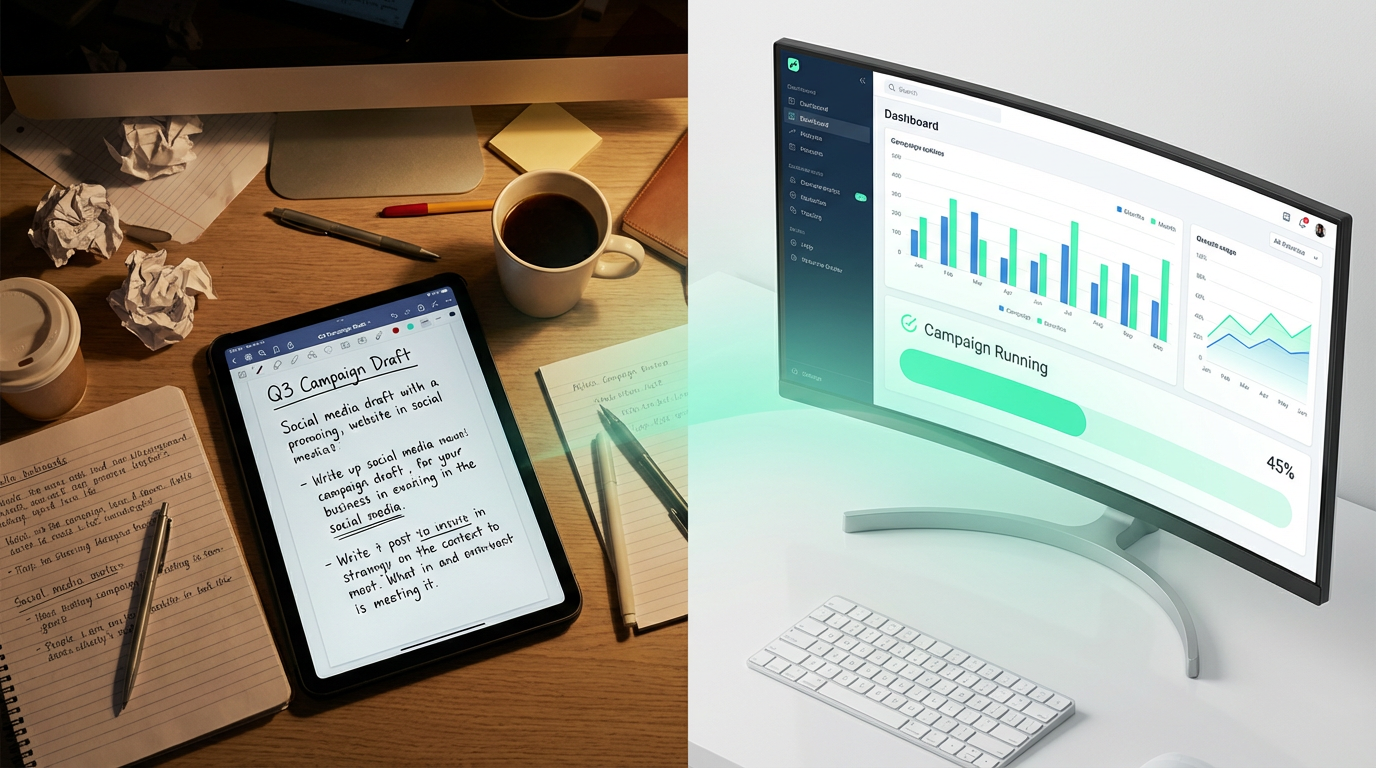
| Feature / Outcome | Buffer | Social Media HQ (by Up-Stride) | Winner for Time-Poor SMEs |
|---|---|---|---|
| Content Creation | Fully manual; requires user to write and design all posts. | AI-powered; generates text and image posts based on brand profile. | Social Media HQ |
| Strategy & Ideation | User-defined; you must decide what to post and when. | AI-driven; identifies topics and develops a content strategy. | Social Media HQ |
| Time Investment | High; requires daily/weekly input for content creation and loading. | Low; “Set & Forget” after initial brand setup, with optional review. | Social Media HQ |
| Core Value | Organising and scheduling your manually created content efficiently. | Automating the entire social media function to save time and drive growth. | Social Media HQ |
Data aggregated from public platform information and reviews on Crozdesk and Capterra (2025).
For the UK SME: Which Tool Solves Real-World Business Problems?
For a UK Small and Medium-sized Enterprise (SME), the right tool is the one that solves the most pressing business problem. The Federation of Small Businesses (FSB) ‘New Horizons’ report found that 25% of small businesses identify a ‘lack of time’ as the primary barrier to adopting new digital technologies. This is where the social media hq vs buffer debate becomes crystal clear.
Buffer is an excellent tool, but it still demands the one resource you don’t have: time. You still need to research, write, design, and schedule every single post. It makes a manual process more organised, but the manual process remains.
This is why we built Social Media HQ. Our platform is a direct answer to that lack of time. It’s one of the few true buffer alternatives uk businesses can use to reclaim dozens of hours per month. Instead of hiring a marketing manager (average UK salary >£40,000) or a social media agency (£1,000-£3,000+ monthly retainer), you can deploy an autonomous AI system for a fraction of the cost. With social media’s impact on revenue growing, as shown by Statista (2025) data on UK ad spend, getting it right without draining resources is non-negotiable. If you’re wondering what to use instead of buffer to solve the root problem of limited time, an AI-driven system is the only logical answer.
Frequently Asked Questions
What is the main difference in the social media hq vs buffer comparison?
The core difference in the social media hq vs buffer comparison is philosophy: Buffer is a tool for organising manual tasks, whereas Social Media HQ is an autonomous system to handle the entire function. One helps you manage the work of social media; the other performs that work for you using Artificial Intelligence (AI). This distinction is critical for businesses choosing a long-term solution that scales without requiring more of their time.
What’s better than Buffer for automation?
For true, end-to-end automation, a platform like Social Media HQ is definitively better than Buffer. Whilst Buffer automates the single task of posting pre-made content, it doesn’t automate strategy or content creation. AI-first systems like ours are designed to automate the entire workflow, from topic ideation to final post, making them a superior choice for businesses seeking genuine hands-off management. This is a key reason many look for what’s better than buffer.
What is a Buffer in social media?
In social media, Buffer is a popular software application used for scheduling posts across multiple platforms. It allows users to manage several social media accounts from one dashboard and create a queue of content that will be published automatically at pre-determined times. Its primary function is to save time by batching the work of posting, not creating the content itself. This positions it as a leading social media management tool.
Is Buffer good for social media posting?
Yes, Buffer is a very good and reliable tool for the specific task of social media posting and scheduling. Its user-friendly interface and dependable performance have made it a market leader for years. However, its suitability depends entirely on your needs. If you have the time and skill to create your own content and only need a scheduler, it is an excellent choice. If you lack those resources, it’s not a complete solution.
Which is better, Hootsuite or Buffer?
The choice between Hootsuite vs Buffer often depends on team size and complexity. Hootsuite is generally considered more powerful for larger teams, offering more in-depth analytics, team collaboration features, and social listening streams. Buffer is often praised for its simplicity and superior user interface, making it effective for individuals and small teams focused purely on content scheduling. Both are excellent tools within the manual management category.
What to use instead of Buffer?
Instead of Buffer, you could use Social Media HQ for automation or tools like Hootsuite and SocialPilot for more advanced manual management. an effective alternative depends on why you are replacing Buffer. If you need more powerful analytics and team features, Hootsuite is a strong contender. If your goal is to eliminate the manual work of content creation entirely, an AI-driven platform like ours is the logical next step.
How does AI social media management work?
AI social media management works by using algorithms to automate tasks traditionally done by humans. This includes analysing your brand to understand its voice, identifying trending topics relevant to your audience, generating draft posts (text and images), and scheduling them at optimal times. Advanced systems like Social Media HQ also learn from performance data to improve future content strategy, moving beyond simple scheduling to full-cycle management of your online presence.
Why would a UK SME choose an AI tool?
A UK SME would choose an AI tool to overcome the common barriers of limited time, budget, and specialised marketing skills. According to the FSB, lack of time is a major hurdle for tech adoption. An AI tool like Social Media HQ directly solves this by automating the time-consuming function of social media marketing. This allows the business owner to focus on core operations while still achieving consistent, professional online growth.
Can I trust AI to create brand-aligned content?
Yes, with modern platforms you can trust AI to create brand-aligned content, provided you give it the right inputs. Systems like Social Media HQ use a detailed ‘Brand Voice Profile’ that you define at the start. The AI uses this profile – including your website content, target audience, and desired tone – as its guide for all content generation. You also typically have a review and approval step, which gives you final control and ensures all output matches your brand identity.
What are the 7 types of social media?
Whilst classifications vary, the 7 main types of social media are generally considered to be: social networking (Facebook, LinkedIn), microblogging (X/Twitter), photo sharing (Instagram, Pinterest), video sharing (YouTube, TikTok), discussion forums (Reddit, Quora), business networking (LinkedIn), and review networks (Trustpilot, Yelp). A comprehensive management strategy typically focuses on the 2-3 platforms most relevant to a business’s specific audience, based on demographic data from sources like the Pew Research Center (2024).
Important Considerations and Alternatives
This analysis is based on features and positioning as of March 2026. The social media tool landscape evolves rapidly, and features of both platforms may change. Our comparison focuses on the strategic difference between manual scheduling and AI automation, which we believe is a durable distinction. Data on user satisfaction is aggregated from public sources and may not reflect every individual’s experience.
Whilst this article focuses on Social Media HQ vs. Buffer, other tools exist in the market. For enterprise-level social listening and team management, platforms like Hootsuite or Sprout Social offer robust feature sets. For agencies managing many clients, tools like SocialPilot or Agorapulse provide specialised workflows. These are generally part of the same ‘manual management’ category as Buffer but with different feature strengths, a point often discussed in comparisons like hootsuite vs buffer.
For complex, multi-channel campaigns involving significant paid advertising budgets, or for brands requiring deep human nuance in highly sensitive industries, partnering with a specialised digital marketing agency may be the most appropriate course of action. An AI tool is designed to provide efficiency and scale for core organic social media, but a human expert is invaluable for bespoke, high-stakes strategic counsel.
Conclusion: Why AI-First is the Future for Ambitious SMEs
The social media hq vs buffer decision ultimately comes down to a business’s most valuable asset: time. Buffer is an excellent, efficient tool for organising a task you perform manually. However, for UK SMEs aiming for growth without expanding their marketing headcount, the paradigm is shifting. The choice is no longer just about finding a better shovel; it’s about investing in a self-driving tractor. An AI-first approach offers a solution to the core problem, not just a tool for the task.
If you find yourself asking what’s better than buffer because you need to reclaim your time and achieve consistent results, then an autonomous system is the answer. Social Media HQ was built specifically for this purpose. Discover how our AI-driven platform can run your social media on autopilot, allowing you to focus on what you do best: running your business.
References
- Federation of Small Businesses (FSB) – New Horizons Report – Professional Organisation Report. Found that 25% of small businesses identify ‘lack of time’ as a primary barrier to adopting new digital technologies.
- Stanford University Human-Centered AI (HAI) – AI Index Report (2024) – Academic Annual Report. Tracks the exponential growth in private investment in AI and its increasing integration into business tools.
- UK Government – National AI Strategy (2021) – Government Policy Paper. Outlines a national goal to support the transition to an AI-enabled economy by encouraging adoption across all sectors, including SMEs.
- Pew Research Center – Social Media Fact Sheet (2024) – Research Survey. Provides demographic data on social media platform usage, showing sustained high adoption rates.
- Statista – Social Media Advertising in the United Kingdom (UK) (2025) – Market Data & Forecast. Projects social media advertising spending in the UK to reach tens of billions of pounds.
- Capterra – Compare Buffer vs Hopper HQ (2025) – Software Review Aggregator. Provides user-sourced reviews and ratings comparing features and satisfaction for social media tools.
- Crozdesk – Social Media Management Software Comparison (2025) – B2B Software Marketplace. Offers side-by-side feature and pricing comparisons based on vendor-supplied and user-verified data.
- Quorage – SocialPilot vs Buffer Review (2024) – Tech Review Blog. Analysis comparing features like analytics, scheduling options, and pricing tiers for different social media tools.