
What is AI Content Creation? A Simple Guide for Busy Leaders
Understand how AI content creation saves time and boosts growth, allowing UK business leaders to focus on what matters most.
🎯 Key Takeaway
AI content creation uses artificial intelligence technologies, like large language models, to automatically generate written, visual, or audio content for marketing and communication. For busy leaders, this means reclaiming dozens of hours while consistently publishing high-quality, on-brand material. It’s a strategic tool that levels the playing field, allowing Small and Medium-sized Enterprises (SMEs) to produce content at a scale that was once only possible for large corporations. However, it requires strategic oversight to maintain brand voice and ensure factual accuracy.
Struggling to find the time for marketing is a familiar story for many UK business leaders. Between managing operations, serving clients, and leading your team, creating consistent, high-quality content often falls to the bottom of the list. Yet, a strong online presence is non-negotiable. This is where the strategic use of ai content creation transforms from a buzzword into a powerful business asset. It’s not about replacing human creativity; it’s about augmenting it, automating the repetitive tasks so you can focus on strategy and growth. This guide offers a no-nonsense look at how ai for marketing smes can revolutionise your workflow, save you time, and drive tangible results.
👤 Written by: Social Media HQ Content Team
Reviewed by: Social Media HQ Editorial Team, Experts in marketing technology for UK SMEs
Last updated: 21 March 2026
ℹ️ Transparency Disclosure: This article explores AI content creation based on our analysis of industry reports, government strategies, and our own platform data. Our goal is to provide clear, actionable insights. Some links may connect to our services. All information is verified by our editorial team for accuracy. Social Media HQ is a division of Up-Stride.
What Are the Real-World Benefits of AI Content Creation for UK SMEs?
Yes, the benefits of ai content creation are substantial and directly address the biggest challenges faced by UK SMEs. The primary advantages are significant time savings, major cost efficiencies, and a newly levelled competitive landscape. For a business leader, this translates to more time spent on the business, not just in it.

First, the efficiency gains are enormous. Many leaders feel they lack the time to adopt new technologies, a challenge highlighted in a report from the Federation of Small Businesses (FSB) (2022) which found 25% of small businesses struggle with this very issue. AI tackles this head-on by automating the most time-consuming parts of content creation, from drafting blog posts to scheduling social media updates. In our work with UK businesses, we’ve seen this save teams more than 15 hours every single week.
Second, it’s incredibly cost-effective. The cost of hiring a full-time content manager or retaining a marketing agency can be prohibitive for many SMEs. AI platforms provide a powerful alternative, offering sophisticated content capabilities for a fraction of the price. This makes high-level ai for marketing smes accessible, not just a luxury for large corporations.
Finally, it provides a crucial competitive edge. AI enables you to maintain a consistent, professional, and engaging online presence without the constant manual effort. This consistency builds brand authority and keeps you top-of-mind with customers. It’s about empowering smaller businesses to punch above their weight, a goal also supported by the UK Government’s national strategy to encourage AI adoption.
Case Study: How a UK firm saved 15+ hours weekly through AI
Challenge: A UK professional services firm was dealing with the ‘hidden cost’ of manual data entry and social media management, which wasted valuable fee-earner time and increased operational costs.
Solution: We implemented automated workflows for their social media and client management, letting an AI handle the research, drafting, and scheduling.
Results: The firm saved 15+ hours weekly, freeing up senior staff for high-value client work.
Key Insight: AI automation can significantly reduce time spent on manual tasks, leading to substantial efficiency gains for professional services SMEs.
How Does AI Content Creation Work?
It works by using trained models to recognise patterns in vast amounts of data and then generate entirely new text or images based on that understanding. Think of it less like magic and more like a highly advanced autocomplete that understands context, tone, and intent. It’s not thinking; it’s predicting the most logical sequence of words or pixels based on the instruction you give it.

At its core are two key concepts. The first is Generative AI, a category of Artificial Intelligence (AI) that can produce novel content rather than just analysing or categorising existing data. The second is the Large Language Model (LLM), the engine that powers most text-based generative AI. An LLM is a complex neural network trained on a massive dataset of text and code from the internet.
The rapid advancement in these models, tracked in the annual Stanford University HAI report, is why they can now produce such human-like text. For the user, the process is beautifully simple and typically follows three steps:
- Input/Prompt: You provide the AI with a clear instruction, question, or command. The more specific your prompt, the better the output.
- Generation: The AI processes your request and generates the content-a blog post draft, a social media caption, an email-in seconds.
- Refinement: This is the crucial human step. You review, edit, and fact-check the AI’s output, adding your unique expertise and brand voice to make it your own.
What Can AI (and Cannot) Create for Your Business?
AI can create an astonishingly wide range of marketing content, but it’s vital to understand its strengths and where human oversight remains critical. It’s a powerful assistant, not a replacement for strategic human thought.
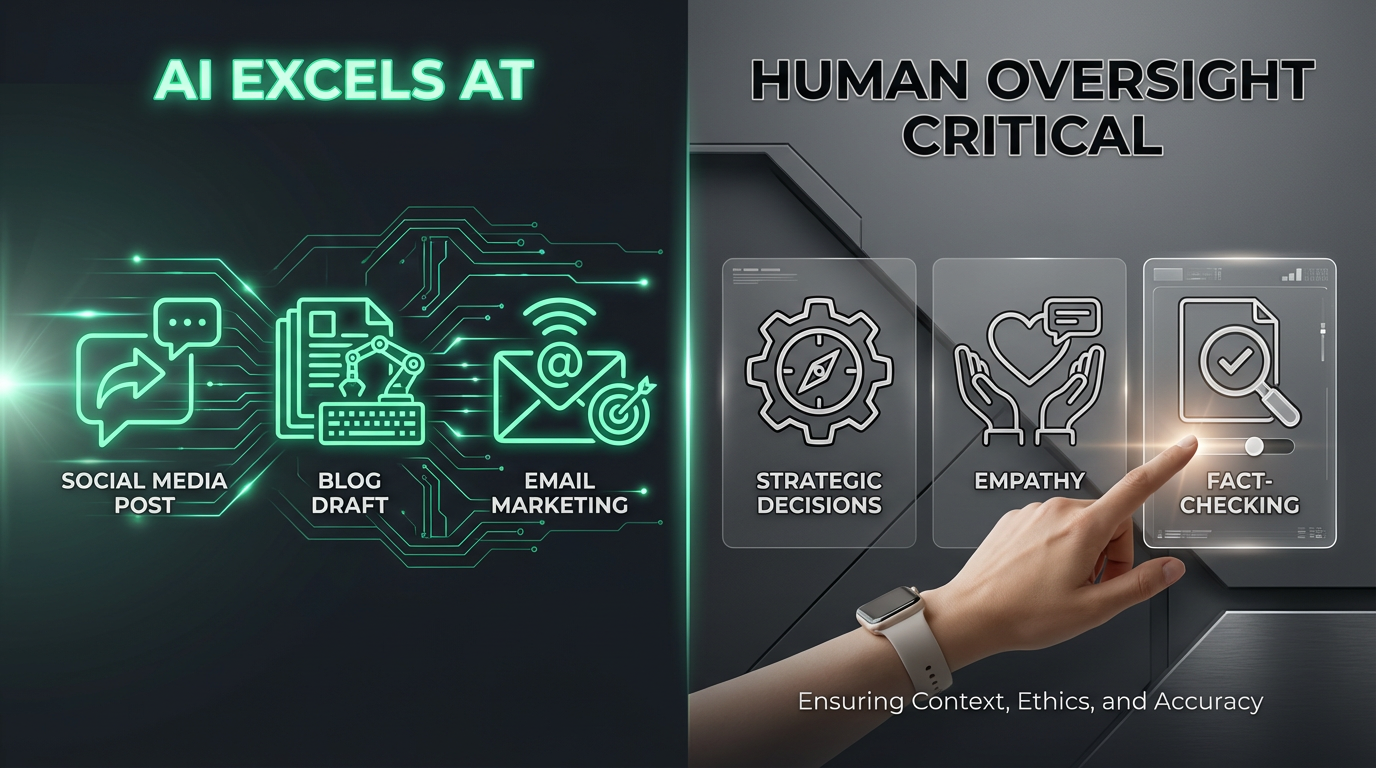
What AI Excels At
- Social Media Posts: Generating captions, ideas, and hashtags for all major platforms. This is a core function of automated social media content systems.
- Blog Post Drafts: Creating well-structured outlines and first drafts on a given topic, which you can then refine.
- Email Newsletters: Drafting engaging copy for promotional campaigns, company updates, and customer communications.
- Ad Copy Variations: Producing dozens of different headlines and body copy options for A/B testing on platforms like Facebook and Google.
- Video Scripts: According to Pew Research Center data on platform usage, short-form video is key. AI can quickly script short videos for platforms like Instagram Reels or TikTok.
Where Human Oversight is Critical
- Final Strategic Decisions: AI can suggest a strategy, but the final decision on brand positioning and campaign direction must be human-led.
- Deep Niche Expertise: For highly technical or specialised content, AI can provide a starting point, but an expert must verify and add nuanced insights.
- Content Requiring True Empathy: Writing a delicate customer apology or a deeply personal brand story requires a human touch that AI can’t yet replicate.
- Fact-Checking Sensitive Data: AI models can ‘hallucinate’ or present false information confidently. All stats, figures, and important claims must be verified by a human, especially with billions of pounds in UK ad spend at stake, as noted by Statista forecasts.
The Critical Choice: DIY AI Tools vs. Fully Automated Systems
an effective choice between a Do-It-Yourself (DIY) tool and a fully automated system depends entirely on your available time and strategic goals. It’s a classic trade-off: saving money versus saving time. In our view, for a busy leader, time is the more valuable currency.
DIY tools, like a standalone ChatGPT subscription, are a great entry point. They’re a powerful ai content generator uk businesses can use for a low monthly cost. However, the ‘hidden cost’ is the significant time investment required. You become the strategist, the prompt engineer, the editor, the fact-checker, and the scheduler. It’s hands-on, and whilst powerful, it still demands hours of your week.
In contrast, a fully automated social media system is designed to eliminate that time sink. Our Auto-Run system, for example, is built to handle the entire workflow. After a quick setup where we lock in your brand, voice, and goals, the platform handles the strategy, content creation, and scheduling for you. It’s a “set up once. Let it run forever.” approach that delivers automated social media content with no ongoing effort. No agency.
The table below breaks down the key differences:
| Factor | DIY AI Tools (e.g., ChatGPT) | Fully Automated System (e.g., Social Media HQ) |
|---|---|---|
| Time Investment | High (5-10 hours/week for prompting, editing, scheduling) | Very Low (<1 hour/week for review, if desired) |
| Strategic Input | Requires you to develop the strategy and prompts | AI-driven strategy based on your brand profile and goals |
| Workflow | Manual: Generate > Copy > Paste > Edit > Schedule | Fully automated: Strategy > Creation > Posting > Optimisation |
| Consistency | Dependent on your discipline and available time | likely to support weekly content, running on autopilot |
| Cost | Low monthly subscription (£20-£50) | Higher monthly investment (£200-£500+) |
| Learning Curve | High (requires learning ‘prompt engineering’) | Low (designed to be live in under 24 hours) |
Common Pitfalls & Best Practices for Strategic AI Content Creation
Yes, there are common mistakes when implementing ai content creation, but they are all avoidable with the right strategy. The biggest error is treating AI as a magic button instead of a powerful tool that requires human direction.
Here are the most frequent pitfalls and how to steer clear of them:
- The Pitfall: Generic, Soulless Content.
The most obvious sign of lazy AI use is content that sounds robotic and lacks personality. This happens when you simply copy and paste the AI’s first draft.
an effective Practice: typically treat the AI’s output as a first draft. Your job is to inject your brand’s unique voice, stories, and opinions. Use it to beat the blank page, not to write the final word.
- The Pitfall: Factual Errors and ‘Hallucinations’.
AI models can invent facts, sources, and statistics with alarming confidence. Publishing these errors can severely damage your credibility.
an effective Practice: Institute a strict human-in-the-loop policy for fact-checking. If the AI mentions a statistic, find the original source. If it makes a claim, verify it. Rarely trust, typically verify.
- The Pitfall: Ignoring Brand Voice.
Without proper guidance, an AI will produce content in a generic, neutral tone that does nothing to build your brand.
an effective Practice: Create a simple brand style guide for your AI. Better yet, use a system that allows you to build a locked brand profile, ensuring every piece of content is aligned. This is central to delivering AI-driven campaign strategies that actually work.
- The Pitfall: Forgetting UK-Specific Rules.
Using global AI tools without considering local regulations can be risky. For example, the data you input could be used for training, which may have implications under the General Data Protection Regulation (GDPR).
an effective Practice: Understand the data policies of any tool you use. Favour platforms that are designed with UK and European privacy standards in mind and have clear policies on data usage.
Frequently Asked Questions
What is ai content creation?
AI content creation uses artificial intelligence to automatically produce marketing materials like social media posts, blogs, and emails. It helps businesses save significant time and scale their content output effectively. However, it typically works best when combined with strategic human oversight to ensure quality, accuracy, and brand alignment.
What are the main benefits of using AI for content?
The primary benefits of ai content creation are massive time savings, reduced costs compared to agencies, and the ability to maintain a consistent online presence. This powerful combination allows SME leaders and their teams to focus on core business activities while still competing effectively in the digital space.
Is AI-generated content penalised by Google?
No, Google does not penalise AI-generated content as long as it is high-quality, original, and helpful to the user. Google’s official stance is that it rewards good content, regardless of how it’s produced. Low-quality, spammy content will perform poorly whether it’s written by a human or an AI.
How do I start content creation for beginners using AI?
For beginners, the easiest way to start is with a user-friendly AI writing assistant to help draft social media posts or blog ideas. We advise starting small by focusing on one channel. Typically edit the AI’s output to add your unique brand voice and perspective. This approach helps you learn without feeling overwhelmed.
What are common content creation mistakes to avoid with AI?
The most common mistake is publishing AI-generated content without review, which can lead to factual errors or a generic tone. Other common ai content creation mistakes include not providing the AI with enough context about your brand and failing to rigorously fact-check its outputs before they go live.
Can AI maintain my unique brand voice?
Yes, AI can learn and replicate your brand voice if you provide it with clear guidelines, style examples, and brand documents. Advanced automated systems can build a comprehensive brand profile to ensure all generated content is perfectly aligned. That said, initial human input is essential for teaching the AI successfully.
What is the difference between an AI writer and an automated platform?
An AI writer is a tool that helps you write, while an automated platform is a system that manages the entire process for you. The writer is like a helpful assistant that you must actively manage; the platform is like a self-sufficient team member that handles strategy, creation, and scheduling, and gets smarter every week.
How much do AI content tools cost in the UK?
Costs for AI content tools in the UK vary widely, from around £20 per month for a simple DIY writer to over £500 per month for a fully automated platform. The price directly reflects the level of automation, strategic capability, and, most importantly, the amount of time you save.
What are the 4 pillars of content, and how can AI help?
The four pillars are typically Entertain, Educate, Inspire, and Convince, and AI can help generate ideas and drafts for all four types. For example, you can prompt it to create an educational blog post, draft an inspiring customer story, write an entertaining social media caption, or generate convincing product descriptions.
Can I be a content creator with no experience if I use AI?
Yes, AI significantly lowers the barrier to entry, allowing those with no prior experience to create high-quality draft content almost instantly. However, an effective results typically come from combining AI’s power with your own subject matter expertise. Your insight is what turns a good draft into great content.
Important Considerations and Limitations
While the potential of AI is immense, it’s crucial to approach it with a clear understanding of its current limitations. AI is a tool, not a silver bullet. Acknowledging its boundaries is the first step toward using it effectively.
First, AI can lack true human creativity, deep emotional intelligence, and up-to-the-minute expertise on fast-moving or niche topics. There is also a persistent risk of ‘AI hallucinations,’ where the model presents plausible but entirely incorrect information. This makes human fact-checking and strategic oversight strongly indispensable, especially for content that impacts your brand’s reputation.
The primary alternatives to using AI include hiring a freelance content creator, partnering with a digital marketing agency, or building a small in-house content team. A freelancer offers flexibility, an agency provides broad expertise, and an in-house team ensures deep brand knowledge. Each has different implications for cost, time, and control. AI-driven platforms like ours often represent a balanced middle ground for time-poor SMEs seeking scalability and efficiency.
Finally, it’s important to know when to consult human professionals. For developing your core brand strategy, defining a complex unique selling proposition (USP), or navigating a public relations crisis, the nuanced judgment of human marketing experts is paramount. Use AI as a tool for executing and scaling your strategy, not as a replacement for high-level strategic thought.
Your Next Step Towards an Effortless Content Strategy
Effective ai content creation is no longer a future concept but a present-day strategic advantage for UK SMEs. By understanding its benefits, choosing the right approach-whether DIY tools or a system like our Auto-Run platform-and implementing best practices for quality control, busy leaders can reclaim invaluable time and amplify their marketing impact. You don’t need to become a tech expert to reap the rewards.
If the prospect of saving time while running a data-driven content strategy sounds appealing, a fully automated platform is the logical next step. These systems go beyond simple text generation to manage your entire social media presence, ensuring you’re typically active, typically on-brand, and typically improving.
See how Social Media HQ puts your content on autopilot.
References
- Federation of Small Businesses (FSB) – 2022 Report. This research on UK small businesses found that 25% are challenged to adopt new technology due to a lack of time.
- Stanford University Human-Centered AI (HAI) – Annual AI Index Report. This comprehensive academic report tracks the exponential growth in AI model performance and its increasing economic impact.
- UK Government – National Strategy Publication. This document outlines the UK’s 10-year goal to become a global AI superpower, encouraging AI adoption across all sectors, including SMEs.
- Pew Research Center – Ongoing Research Fact Sheet. This long-term study provides demographic data on social media platform usage, showing adoption rates by age.
- Statista – Market Forecast Data. This market analysis projects that social media advertising spend in the UK will continue to grow significantly, highlighting the value of optimised content.
- Indeed UK – Career Advice Publication. This guide for professionals outlines the core steps to creating quality content, reinforcing the importance of planning and editing stages that AI can assist with.
Conclusion
Your Next Step Towards an Effortless Content Strategy
In summary, ai content creation is no longer a future concept but a present-day strategic advantage for UK SMEs. By understanding its benefits, choosing the right approach—whether DIY tools or fully automated systems—and implementing best practices for quality control, busy leaders can reclaim valuable time and amplify their marketing impact. You don’t need to become a tech expert to reap the rewards.
If the prospect of saving time while running a data-driven content strategy sounds appealing, a fully automated platform is the logical next step. These systems go beyond simple text generation to manage your entire social media presence, ensuring you’re consistently active, consistently on-brand, and consistently improving.
[See how Social Media HQ puts your content