
How to Automate Content Creation with AI: A Step-by-Step Guide for UK SMEs
🎯 Key Takeaway
To effectively automate content creation with AI, UK Small and Medium-sized Enterprises (SMEs) must move beyond simple text generation and adopt a strategic system that integrates brand strategy, content planning, multi-platform posting, and performance analysis into a single, cohesive workflow. Complex DIY ‘toolchains’ using multiple apps often create more work and fail to deliver true automation for time-poor business owners. Effective automation is strategy-driven, focusing on content pillars and campaign goals, not just one-off post generation. An integrated platform offers a more efficient, cost-effective, and strategically sound solution than managing multiple separate tools.
The hype around Artificial Intelligence (AI) promises endless content at the click of a button. However, for many UK SME leaders, a frustrating cycle of wrestling with prompts, editing generic text, and juggling multiple software subscriptions. The promise to automate content creation with AI often dissolves into a new, time-consuming manual job. This guide tackles that disconnect. True automation isn’t about using a tool to generate social media content with AI for a single post; it’s about building a self-sufficient content engine that runs on its own. As of March 2026, the rapid advancement of this technology, tracked in reports like the Stanford HAI Annual Report, means that genuine automation is now accessible. We’ll show you the practical, step-by-step path from manual effort to a genuine ‘set up once, let it run forever’ system that saves you time and drives real business growth.
👤 Written by: Social Media HQ Content Team
Reviewed by: Social Media HQ Editorial Team, Experts in AI-driven marketing automation for UK SMEs
Last updated: 20 March 2026
ℹ️ Transparency Disclosure: This article explores how to automate content creation with AI based on an analysis of current market tools, industry best practices, and data from recognised research organisations. Transparency is key to our approach. This Disclosure indicates that some links may connect to our services, such as our fully automated social media system. All information is verified by our editorial team for accuracy and relevance as of the publication date.
Why DIY AI Workflows Fail UK SMEs: The Hidden Costs of Complexity
The most common approach to automation is the ‘Toolchain Trap’, but it rarely works for busy SMEs. This involves stitching together multiple separate tools-like using ChatGPT for ideas, another AI for images, Zapier to connect them, and a social scheduler like Buffer to post. While it sounds clever, this fragile system creates more problems than it solves. The primary issue is complexity. Data from the Federation of Small Businesses (FSB) (2022) shows that a lack of time is a key barrier to tech adoption for 25% of SMEs. A complicated ai content workflow with multiple points of failure is the last thing a time-poor business owner needs.

The hidden costs quickly add up. You’re not just paying for multiple subscriptions (often in USD with poor exchange rates), you’re paying with your time. Hours are lost to initial setup, ongoing maintenance when one tool updates and breaks the chain, and the constant mental load of managing different interfaces. This isn’t true automation; it’s just a different kind of manual labour. Effective social media automation for smes should reduce your workload, not just change it.
Case Study: How a UK firm saved 15+ hours weekly through AI
Challenge: Focus on immediate pain points of UK SME leaders: wasted time and rising operational costs. The ‘hidden cost’ of manual data entry in UK Professional Services.
Solution: Automated workflows and lead research/client management automation for professional services.
Results: saved 15+ hours weekly
Key Insight: AI automation can significantly reduce time spent on manual tasks, leading to substantial efficiency gains for professional services SMEs.
The Strategic Automation Framework: From Ideas to Autopilot
An effective system begins with strategy, not just generation. An automated content strategy is a system that plans, creates, and learns on your behalf. It moves beyond asking an AI “write me a post about X” and instead tasks it with “execute my Q2 marketing goals”. The foundation of this approach is ‘Content Pillars’ – the core themes and topics your brand wants to own. These are the subjects you should be known for.

A truly intelligent system can analyse your website, services, and business objectives to help define these pillars. According to the UK Government’s policy paper on its National AI Strategy, encouraging this kind of strategic adoption is a key national goal for transitioning to an AI-enabled economy. Once your pillars are locked in, the AI can generate an entire campaign roadmap, creating a diverse mix of content that consistently reinforces your brand’s message. This is the core of our Auto-Run system: building a locked brand profile that drives every piece of content, ensuring strategic alignment without any ongoing effort from you. This is how social media automation for smes transforms from a time-sink into a powerful, strategic asset.
How to Truly Automate Content Creation with AI: A 5-Step Guide
Moving from manual chaos to automated efficiency requires a structured approach. It’s not about finding a magic button, but about building an intelligent system. We recommend following these five steps to implement a genuine ai content workflow that delivers results.
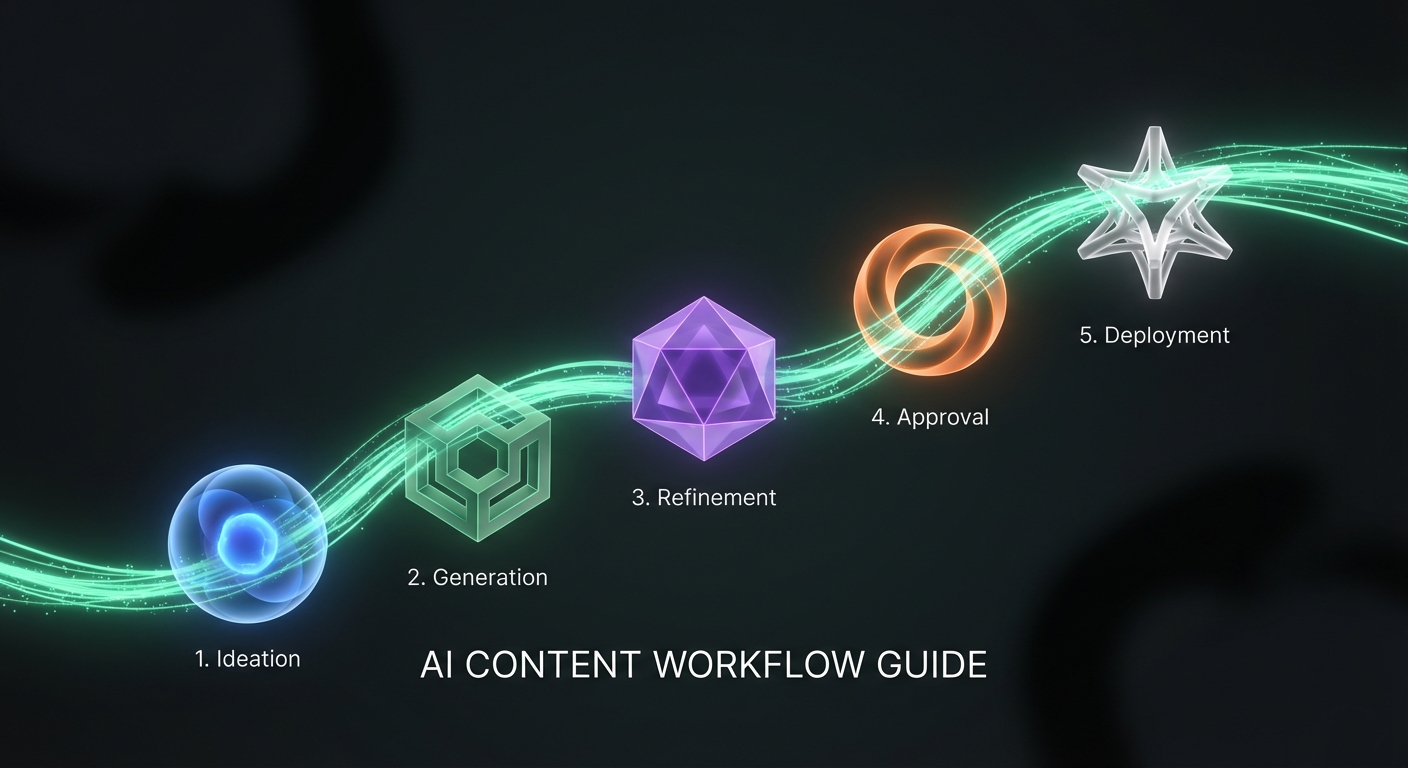
- Define Your Digital Brand Identity: The process starts with the AI performing a deep analysis of your digital footprint. It scans your website, existing blog posts, and company values to create a comprehensive Brand Profile. This profile codifies your unique tone of voice, key messaging, and brand personality, serving as the “brain” for all future content.
- Establish Strategic Content Pillars: Based on your Brand Profile and business goals, the system identifies 3-5 core Content Pillars. These are the high-level themes your content will revolve around to build authority and attract your target audience. For a business coach, pillars might be ‘Leadership’, ‘Productivity’, and ‘Team Culture’.
- Choose Your Automation Engine: Here you face a choice: the complex DIY toolchain or a unified, integrated system. As we’ve discussed, for most SMEs, an all-in-one platform is the superior option. Systems like our Auto-Run are designed to handle this entire process, from strategy to posting, within a single interface.
- Configure and Supervise the System: This is the “set it” part of “set it and forget it”. You’ll configure your desired posting frequency, the mix of content pillars, and which social platforms to target. You can also enable a review mode, which allows you to approve all content before it goes live, giving you full control without the creation burden.
- Analyse and Refine: The system doesn’t just post; it learns. It uses AI-powered analytics to track engagement, reach, and other key metrics. It identifies which topics, formats, and posting times perform best, and then uses that data to automatically refine its future content strategy. The system
gets smarter every week, ensuring your social media is typically running on autopilot and continuously improving.
Choosing Your Path: DIY Toolchains vs. An Integrated System
an effective path forward depends on one question: do you want to become an automation engineer or a business owner whose marketing runs itself? For most UK SMEs, the answer is the latter, which makes an integrated system the clear winner. A DIY approach using multiple ai content creation tools uk might seem cheaper at first glance, but the total cost of ownership tells a different story.
An integrated system like Social Media HQ is built from the ground up to handle the entire content lifecycle. There are no fragile connections to maintain, no multiple subscriptions to juggle, and support is unified and UK-based. It’s a strategic investment in efficiency. The choice is between a time-consuming hobby and a professional tool that delivers measurable results with no ongoing effort. No agency.
| Factor | DIY Multi-Tool Workflow (e.g., ChatGPT + Zapier) | Integrated System (e.g., Social Media HQ) |
|---|---|---|
| Total Monthly Cost | £50 – £150+ (multiple subscriptions, often in USD) | One predictable monthly fee (£) |
| Time Investment | 5-10 hours/week (setup, maintenance, prompt writing) | <1 hour/week (review & approval only) |
| Strategic Alignment | Manual & inconsistent; relies on user input for every post | Automated; AI generates content based on locked-in strategy |
| Scalability | Difficult; adding platforms or content types requires new tools | Seamless; built to automate multi platform social media content |
| Support | Fragmented; multiple vendors, often in US time zones | Unified, UK-based support team |
Data compiled from market analysis and insights from Statista on market costs and FSB on SME time constraints.
Automating for Different Platforms: Tailoring AI Content for UK Audiences
A truly intelligent system can automate multi platform social media content by understanding that each platform has a different audience and purpose. It’s not enough to simply generate social media content with ai and blast it everywhere. The content must be contextually adapted. For example, a system can take a single core idea and transform it into a professional, data-rich post for LinkedIn, a visually engaging and conversational post for Instagram, and a concise, link-driven update for Twitter (now X).
This adaptation is especially important for connecting with UK audiences. Sophisticated AI can be trained on UK-specific language, cultural nuances, and business etiquette, ensuring your content feels authentic and relevant. It knows the difference between ‘trousers’ and ‘pants’ and understands when a bit of dry humour is appropriate. Data from the Pew Research Center on social media demographics reinforces this need; the audience on LinkedIn is vastly different from the one on TikTok. A one-size-fits-all approach fails. Smart automation ensures your message is perfectly tailored for every platform, every time.
Frequently Asked Questions
What does it mean to automate content creation with AI?
To automate content creation with AI means using a system to handle the entire content lifecycle, from strategic planning and generation to multi-platform scheduling and performance analysis, with minimal human intervention. It’s a holistic approach that goes far beyond simply using an AI tool to write a single social media post. This method ensures consistency and saves significant time for your business.
Is AI-generated content penalised by search engines?
No, search engines like Google prioritise high-quality, helpful content, regardless of how it’s produced. As long as the AI-generated content is original, valuable, and meets user intent, it is not penalised. The key is to use AI as a tool to create genuinely useful content, not to generate low-quality spam. This requires a system with strong strategic capabilities.
How much time can I realistically save?
Businesses can save over 10 hours per week by moving from manual content creation or complex DIY workflows to a fully integrated automation system. This time is reclaimed from tasks like brainstorming, writing, editing, scheduling, and managing multiple tools. The actual time saved depends on the scale of your current content efforts and the efficiency of the system you choose.
Can AI truly understand my brand’s unique voice?
Yes, modern AI systems can be trained to understand and replicate a specific brand voice with remarkable accuracy. By analysing your website, existing content, and brand guidelines, the AI learns your specific tone, terminology, and style. A ‘review mode’ is still recommended to ensure all content remains perfectly on-brand before it’s published, giving you the final say.
What are an effective AI content creation tools for UK SMEs?
an effective tool depends on your goal; for simple text generation, tools like ChatGPT are popular, but for true automation, integrated systems are superior. For UK SMEs, platforms like Social Media HQ that combine strategy, creation, and scheduling with localised support offer the most value. This avoids the complexity and hidden costs of managing multiple separate ai content creation tools uk.
How does an automated content strategy work?
An automated content strategy uses AI to analyse your business goals and market data to identify key content pillars and campaign themes. The system then automatically generates a content calendar with posts that support these strategic objectives. It’s a proactive approach that ensures all of your content serves a specific, pre-defined purpose for growing your business.
Can I automate content for multiple platforms like LinkedIn and Instagram?
Yes, a key benefit of advanced automation systems is the ability to automate multi-platform social media content. The system can create a core piece of content and then intelligently adapt its tone, format, and hashtags for each specific platform. This ensures your message is optimised for the unique audiences on LinkedIn, Facebook, Instagram, and more, all automatically.
What are the main risks of using AI for content?
The primary risks include potential factual inaccuracies, generating generic or off-brand content, and an over-reliance that stifles human creativity. These risks are best mitigated by using a high-quality AI system with a strong strategic engine and typically having a human review process in place. This simple step ensures both quality and brand alignment remain high.
How much does it cost to automate content creation?
Costs vary significantly; a DIY approach with multiple tool subscriptions can range from £50 to £150+ per month, plus the hidden cost of your time. An all-in-one integrated system typically offers a single, predictable monthly fee that provides far better value and a higher return on investment. Typically factor in the significant time saved when comparing costs.
How do I get started with content automation?
an effective way to start is by defining your goals and auditing your current process to identify time-wasting tasks. Then, evaluate whether a DIY toolchain or an integrated system is a better fit for your time and budget. We recommend starting a free trial of an integrated platform to experience the benefits of true automation firsthand without any commitment.
Important Considerations
While AI is a powerful accelerator, it is not a substitute for human expertise and final judgment. The data used to train AI models, such as those cited by the Stanford University Human-Centered AI (HAI) (2024) report, ends at a specific point, meaning AI may lack awareness of very recent events. Also, AI can sometimes produce plausible-sounding but factually incorrect information. Therefore, a human review and approval stage is a critical component of any responsible ai content workflow to ensure accuracy and brand safety.
The primary alternative to an AI automation system is manual content creation, either in-house or by hiring a freelance writer or marketing agency. While manual creation offers maximum control, it is significantly more time-consuming and less scalable. Agencies provide expertise but come at a much higher cost, often thousands of pounds per month. The choice depends on your business’s specific balance of budget, available time, and desired level of strategic control.
We recommend that businesses in highly regulated industries, such as finance or healthcare, implement a more rigorous legal and compliance review process for all AI-generated content. While AI can be tailored to adhere to guidelines, the ultimate responsibility for compliance rests with the business. For complex brand repositioning or crisis communications, consulting with a senior marketing strategist is typically advisable.
Reclaim Your Time and Grow on Autopilot
The journey to successfully automate content creation with AI requires a shift in mindset from simple generation to strategic automation. By moving beyond complex and inefficient DIY workflows, UK SMEs can implement a cohesive system that not only saves countless hours but also builds a more effective, data-driven automated content strategy. This approach transforms social media from a daily chore into a scalable growth engine for your business, live in under 24 hours and running on autopilot.
Ready to stop tinkering with tools and start running your social media efficiently? Social Media HQ provides the integrated, AI-powered system designed to put these principles into practice for your UK business. Start your free 7-day trial to experience true automation.
References
- Federation of Small Businesses (FSB) – 2022 Report. This study found that 25% of UK small businesses identify lack of time as a key barrier to adopting new technology.
- Stanford University Human-Centered AI (HAI) – Annual Report (2024). This academic index tracks the exponential growth in AI capabilities and corporate investment, indicating its increasing integration into core business functions.
- UK Government – Policy Paper. Outlines a national ambition to support the transition to an AI-enabled economy by encouraging adoption across all sectors, including SMEs.
- Pew Research Center – Longitudinal Study. Provides demographic data on social media platform usage, showing distinct audience profiles for platforms like LinkedIn and Instagram.
- Statista – Market Forecast. This data projects UK social media advertising spend to reach new heights, underscoring the financial importance of an optimised content strategy.
- Medium – User Experience Article (2023). A first-hand account from a content creator shows how automating workflows with AI can help repurpose content and focus on strategy over repetitive tasks.
- Copy.ai – Industry Blog (2024). This guide for marketers outlines best practices for scaling content creation with AI, emphasizing the importance of starting with a clear brief and goals.
- Back to all articles


Stop reading.
Start automating.
Your 7-day free trial includes full Pro access — no credit card needed, no obligation.