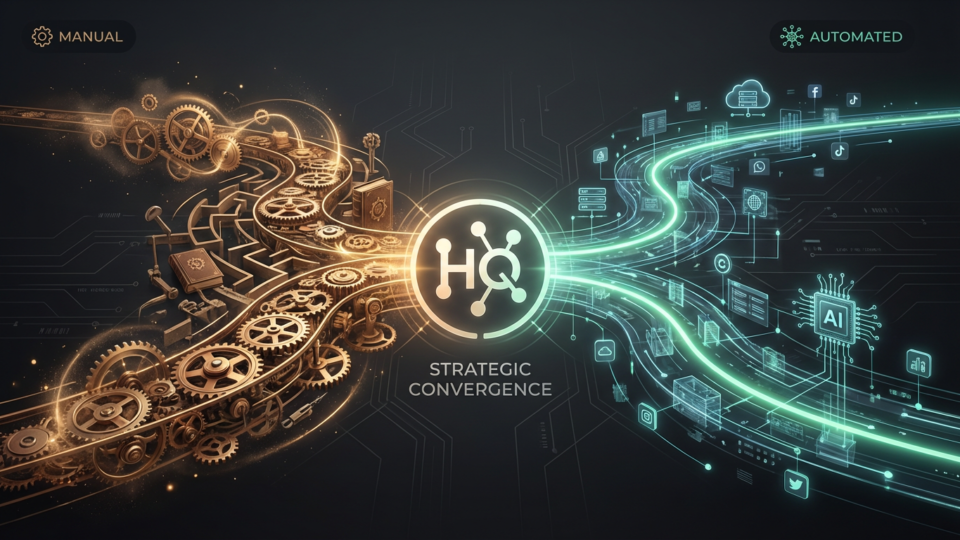
Manual vs Automated Social Media: A Definitive Guide for UK Business Leaders
🎯 Key Takeaway
The debate over manual vs automated social media for UK businesses centres on a trade-off: manual posting offers granular control but is time-intensive, while automation provides efficiency and scale, with modern AI-driven systems now offering sophisticated strategic capabilities. Our analysis shows that for time-poor leaders, a fully automated system delivers a higher Return on Investment (ROI) than manual or hybrid approaches. This guide analyses which approach is truly best for driving growth in a competitive UK market.
For UK business leaders, maintaining a powerful social media presence feels less like an option and more like a critical, non-stop demand. As of Q1 2026, the pressure is immense. The core challenge isn’t a lack of ambition; it’s a chronic lack of time. This scarcity forces a strategic decision with huge implications for growth: the choice between manual vs automated social media. This isn’t just about picking a tool. It’s about deciding where your most valuable resource – your time – is best spent. This guide moves beyond basic schedulers to deliver a clear verdict, evaluating true Artificial Intelligence (AI) driven strategy against the familiar grind of manual work.
👤 Written by: The Social Media HQ by Up-Stride Content Team
Reviewed by: The Social Media HQ by Up-Stride Editorial Team, Specialists in AI-driven marketing for UK Small and Medium-sized Enterprises (SMEs)
ℹ️ Transparency & Disclosure: This article explores the strategic choice between manual and automated social media management based on industry reports, government data, and our team’s expert analysis. At Social Media HQ by Up-Stride, we provide a fully automated AI social media solution. This article reflects our expert, human-centric perspective on helping businesses achieve more with less effort.
The Old Way: Understanding Manual Social Media Management (and its Hidden Costs)
Manual social media management is the completely hands-on process of creating content, posting it to platforms like LinkedIn or Instagram, and engaging with the audience. It’s the default for many businesses starting out. The workflow is intensive, involving brainstorming ideas, writing copy, designing graphics, manually uploading and scheduling posts, and then monitoring for comments and messages. It’s a full-time job disguised as a part-time task.

The most significant issue is the hidden cost. We’re not just talking about the social media management cost UK businesses might pay a freelancer. We’re talking about the owner’s time. According to a report from the Federation of Small Businesses (FSB) (2022), a lack of time is a primary barrier preventing 25% of SMEs from adopting new technology. This time-scarcity problem means every hour spent crafting a post is an hour not spent on sales, strategy, or operations. Analysis from Missinglettr highlights this inefficiency, noting the immense time sink of manual posting.
Also, manual management demands a high cognitive load. Leaders are told to follow complex social media content rules like the ’70/20/10 rule’ (70% value, 20% shared, 10% promotional). Whilst a good principle, consistently executing it is draining and often leads to burnout and inconsistent posting – the very thing that undermines social media success.
What is Social Media Automation and How Has It Evolved?
Social media automation is the use of software to execute social media tasks without manual intervention. However, not all automation is created equal. The term has evolved, and it’s crucial to understand the two distinct tiers of tools available to UK businesses. This distinction is vital as the UK government’s national strategy actively encourages the adoption of AI to build a more productive economy, according to their National AI Strategy publication.
Tier 1: Basic Automation with Scheduling Tools
These are the tools many people think of first: platforms like Buffer or Hootsuite. Their primary function is to automate the act of posting. You still have to manually create the content – the copy, the images, the videos – and then upload it all into the scheduler.
They solve one small part of the problem: you don’t have to be online at the exact moment a post goes live. But they don’t save you time on strategy, ideation, or content creation, which are the most time-consuming parts. They are a small step up from pure manual work, but they don’t address the core issue of resource drain.
Tier 2: Comprehensive Automation with AI Strategy Engines
This is the new frontier of AI social media management. An AI strategy engine is a system that automates the entire workflow, from strategy and content creation to posting and performance analysis. This is what we’ve built at Social Media HQ by Up-Stride.
Instead of just scheduling, these platforms use AI to understand your brand by analysing your website and business goals. Then, they generate strategically relevant content, create entire campaigns, and post them for you. Our proprietary Auto-Run system is a well-suited example. It follows a simple 3-step process:
- Setup & Brand Alignment: We create a locked brand profile, ensuring the AI understands your voice, audience, and objectives.
- Campaign Creation & Auto-Run: The AI generates and schedules a full week of on-brand content. This is a system that is truly running on autopilot.
- AI Learning & Optimisation: The system analyses performance data and gets smarter every week, refining its approach to improve results over time.
This is strategic automation, not just task automation. As the Stanford University Human-Centered AI (HAI) (2024) annual report shows, AI capabilities are advancing at a staggering pace, making this level of sophisticated AI social media management not just possible, but highly effective.
Head-to-Head Analysis: Manual vs Automated Social Media for the UK SME
So, how do these two approaches stack up for a typical UK SME? Let’s move beyond theory and look at a direct comparison across the factors that matter most to a business leader: time, cost, consistency, and strategic impact. The choice between manual vs automated social media becomes much clearer when you see the data side-by-side.
| Factor | Manual Management | AI Strategy Engine |
|---|---|---|
| Time Investment | 10-20+ hours per week | <1 hour per week (after initial setup) |
| Consistency | Difficult to maintain; prone to gaps | Flawless; posts on schedule every time |
| Strategic Focus | Reactive; focused on the next post | Proactive; based on performance data & goals |
| Content Quality | Dependent on daily creativity/mood | Consistently on-brand and data-informed |
| Scalability | Very low; tied directly to one person’s time | Extremely high; can manage multiple platforms easily |
| Data Analysis | Basic; relies on platform-native analytics | Advanced; AI identifies trends and optimises content |
The table makes the trade-offs obvious. Manual management keeps you in total control, but at an immense cost of time and scalability. An AI Strategy Engine, on the other hand, delivers huge efficiency gains. One of the key benefits of social media automation is consistency, which Forbes (2023) notes is crucial for building brand recognition and trust. That consistency is almost impossible to achieve manually without a dedicated team. For a time-poor leader, the hours saved translate directly into more time for client work, sales, and strategic planning.
Why the ‘Hybrid Approach’ Is a Trap for Time-Poor Leaders
The hybrid approach, where you use basic scheduling tools but still create all the content yourself, is often suggested as a safe middle ground. In our experience, for a busy SME leader, this is the worst of both worlds. It combines the strategic burden of manual management with the technical overhead of learning and maintaining automation tools.
You’re still responsible for the entire creative process – the ideation, copywriting, and design. Then, you have to manage another piece of software to schedule it all. This doesn’t solve the core problem of time scarcity; it just rearranges it. It creates fragmented workflows and adds another subscription to the P&L without delivering a significant return on your time. You still do all the hard work.
We firmly believe a fully integrated AI social media management platform is a much more powerful solution. A system like ours consolidates all the tasks into one place. It handles the strategy, creation, and scheduling, freeing you from the day-to-day grind. This allows you to step back and focus on high-level review and, more importantly, running your business. There’s no ongoing effort. No agency.
Calculating the True ROI of AI Social Media Automation
To understand the real value, you have to calculate the total Return on Investment (ROI), not just the platform fee. The benefits of social media automation go far beyond just posting on time.
Here’s a simple framework:
- Hard ROI: This is the direct financial return.
- Formula: (Value of New Leads + Avoided Costs) – Platform Fee
- Avoided Costs could be the salary of a part-time social media manager (often £10,000-£15,000 per year) or expensive agency retainers. With social media ad spend in the UK projected to exceed £9.8 billion in 2024 according to Statista data, optimising every pound spent on marketing is critical.
- Soft ROI: This is the value of time and efficiency gained.
- Formula: Hours Saved Per Week x Your Hourly Value
- If you save 15 hours a week and your time is worth £100/hour, that’s £1,500 of value created each week that you can reinvest into growing the business.
This isn’t just theory. We see it with our clients every day.
Case Study: How a UK firm saved 15+ hours weekly through AI
Challenge: A UK professional services firm was struggling with the ‘hidden cost’ of manual social media and client management, with senior staff wasting hours on repetitive tasks.
Solution: We implemented our automated workflows for lead research and client management, freeing up their team from manual data entry and content creation.
Results: The firm saved 15+ hours weekly.
Key Insight: AI automation can significantly reduce time spent on manual tasks, leading to substantial efficiency gains and allowing experts to focus on billable work.
Investing in one of the right social media automation tools UK businesses can access isn’t a cost centre; it’s a growth driver.
Important Considerations
No AI system is a ‘magic bullet’. The quality of automated content is directly proportional to the quality of the initial brand inputs. An AI strategy engine requires a clear website, defined target audience, and strategic goals to be truly effective. Also, this analysis focuses on organic social media and does not delve deeply into the separate complexities of paid advertising campaign management.
The primary alternatives to an in-house AI platform are hiring a freelance social media manager or engaging a full-service marketing agency. A freelancer can offer a highly personalised touch but may lack strategic depth and can be a single point of failure. An agency provides a team of experts but comes at a significantly higher cost, often starting from £1,500+ per month in the UK for basic services.
Our advice is for business leaders to consider an AI automation platform when they find themselves spending more than five hours per week on social media tasks or feel their efforts lack consistency and strategic direction. If your business requires a complex, multi-channel strategy involving heavy video production or influencer marketing, consulting with a specialised agency may be the most appropriate first step.
Reclaim Your Time: The Verdict for UK Business Leaders
The discussion of manual vs automated social media has evolved. For a growth-focused UK business, manual management is an unsustainable time drain, and basic scheduling tools only solve a fraction of the problem. Our analysis shows that a true AI strategy engine offers the most compelling path forward, combining the consistency of automation with the strategic intelligence needed to compete effectively. It’s the smart choice for leaders who value their time.
By embracing this new generation of automation, you are not losing control; you are gaining a strategic partner. A system powered by our Auto-Run framework takes on the 90% of work that is repetitive and time-consuming, allowing you to focus on the 10% that truly matters: engaging with customers and running your business. See how your social media can run on autopilot. Set up once. Let it run forever.
Frequently Asked Questions
What is the difference between manual vs automated social media?
The core difference in manual vs automated social media is who performs the work. Manual involves a person handling all tasks like writing and posting, offering high control. Automation uses software to perform these tasks, prioritising efficiency and scale. Modern AI automation now also handles the creative and strategic work.
Is automation better than manual social media?
For most time-poor UK business leaders, yes, AI automation is superior to purely manual work. While manual offers a personal touch, the efficiency, consistency, and strategic data analysis provided by a good AI system deliver a far greater return on investment and free up crucial leadership time for other tasks.
What is the 70/20/10 rule in social media?
This is a manual content strategy framework suggesting a specific content mix. It proposes that 70% of your content should be valuable and relevant to your audience, 20% should be shared content from other sources, and 10% should be promotional. It’s a useful guideline but can be challenging to maintain manually.
What is the 80/20 rule in social media?
The 80/20 rule suggests 80% of your content should be non-promotional and 20% should directly promote your business. Also known as the Pareto Principle in this context, its goal is to build an audience by providing consistent value. This is a core principle intelligent automation systems are built on to ensure audience growth.
What is the 5-3-2 rule for social media?
The 5-3-2 rule is another manual content mix ratio for social media. For every ten posts, it recommends five should be curated content from others, three should be original, non-promotional content, and two should be personal, fun posts. Like other social media content rules, it is difficult to execute consistently without significant time.
What are 5 things you should not share on social media?
You should avoid sharing confidential business data, internal disagreements, unsubstantiated claims, divisive topics unrelated to your brand, and copyrighted content. A good AI system is programmed with brand safety filters and learns from your specific brand guidelines to avoid these pitfalls automatically, protecting your brand’s reputation.
Does automation feel less authentic to customers?
Poorly implemented automation strongly can feel robotic, but modern systems avoid this. Sophisticated AI social media management systems are designed to analyse and replicate a specific brand voice, creating content that feels authentic. The key is providing the AI with a strong, clear brand profile to learn from during setup.
What is the cost of social media automation in the UK?
The cost of social media automation tools UK businesses can access varies greatly. Basic scheduling tools might start at £15-£50 per month. Comprehensive AI strategy platforms that handle content creation and optimisation typically range from £100 to £400 per month, which is significantly less than hiring a part-time social media manager.
Can I still engage with my audience if I automate?
Yes, and you strongly should; in fact, you’ll have more time for it. Automation handles the time-consuming tasks of content creation and scheduling. This frees up your time to focus on the high-value activity of engaging directly with comments, messages, and mentions, creating a powerful combination of efficiency and human connection.
How quickly can I set up an automated system?
This depends on the platform, but modern systems are built for speed. While some tools require extensive setup, advanced AI-driven systems like Social Media HQ are designed for rapid onboarding. By analysing your website and asking a few key questions, our platform can have you live in under 24 hours.
References
- Federation of Small Businesses (FSB) – (2022) Report finding 25% of UK SMBs cite lack of time as a barrier to adopting new technology.
- Stanford University Human-Centered AI (HAI) – (2024) Annual Report detailing how AI models are becoming more powerful and cost-effective, outperforming humans on tasks like image classification.
- UK Government – (2021) National Strategy publication outlining the UK’s 10-year plan to support the transition to an AI-enabled economy.
- Pew Research Center – (2023) Survey data showing platform dominance and demographic usage for major social networks.
- Statista – (2024) Market forecast projecting UK social media ad spend to exceed £9.8 billion.
- Forbes – (2023) Council post discussing the benefits of automated posting, including brand consistency and messaging.
- Missinglettr – Blog analysis on the efficiency gains of automation versus the time-intensive nature of manual posting.
- Aimagency.co.uk – Article comparing AI and manual social media management, highlighting differences in strategy and data analysis.
Conclusion
Reclaim Your Time: The Verdict for UK Business Leaders
In summary, the discussion of manual vs automated social media has evolved. For a growth-focused UK business, manual management is an unsustainable time drain, and basic scheduling tools only solve a fraction of the problem. The evidence shows that a true AI strategy engine offers the most compelling path forward, combining the consistency of automation with the strategic intelligence needed to compete effectively.
By embracing this new generation of automation, you are not losing control; you are gaining a strategic partner. A system like Social Media HQ takes on the 90% of work that is repetitive and time-consuming, allowing you to focus on the 10% that truly matters: engaging with customers and running your business. Start your free trial today and see how your social media can run on autopilot.