
Why Isn’t My AI Content Getting Engagement? A Diagnostic Guide
🎯 Key Takeaway
Poor ai content engagement often stems from a lack of human strategy and brand personality, not a failure of the AI tool itself. It’s a common issue where the efficiency of Artificial Intelligence (AI) isn’t matched by audience connection.
• Generic Voice: AI-generated text often lacks a distinct brand voice, sounding robotic and failing to connect with audiences.
• Strategic Disconnect: Isolated AI posts without a link to broader business goals or campaign objectives rarely drive meaningful interaction.
• Audience Mismatch: Content fails when it doesn’t address the specific pain points, interests, or cultural nuances of your target UK audience.This guide provides a diagnostic checklist and a step-by-step framework to transform your AI outputs into engaging, brand-aligned content.
You’ve invested in AI to streamline content creation, but the results are falling flat. The posts are published, the schedule is consistent, yet you’re met with silence: minimal likes, few comments, and disappointing shares. This experience of low social media engagement is frustratingly common for businesses. The promise of AI saving time is real, but if it doesn’t generate results, it’s an empty victory. As of March 2026, with the UK government actively promoting an AI-enabled economy, mastering this tool is a competitive necessity.
The issue often isn’t the technology itself. The problem is the process. For ai content engagement, the gap between a generic AI output and a piece of content that truly resonates is strategy. This guide offers a pragmatic, diagnostic approach to fix what’s broken. We’ll provide a checklist to identify the root is associated with and a framework to build a better, more human-centric content process.
Written by: Social Media HQ (by Up-Stride) Content Team | Reviewed by: Editorial Team, Industry Specialists
Last updated: 15 March 2026
ℹ️ Transparency Disclosure: This article explores the common is associated with of low engagement for AI-generated content based on market analysis and our team’s specialised experience. Our goal is to empower you with actionable solutions. Some links may connect to our services. All information is verified by our editorial team. Social Media HQ is a division of Up-Stride.
Your Diagnostic Checklist: 7 Reasons for Low AI Content Engagement
The most direct answer to ‘why is my content not engaging?’ is that it likely lacks a human touchpoint in strategy, personality, or value. AI is a powerful tool for execution, but it requires strategic human direction to create content that connects. Use this checklist to diagnose the specific gaps in your process.

- No Distinct Brand Voice (The Generic Voice Gap): Your AI doesn’t know your brand’s personality unless you teach it. Without specific guidance, it defaults to a neutral, formal tone that is easily ignored. A Brand Voice, the unique personality of a brand in its communications, is essential for recognition and connection.
- No Clear Strategy (The Strategic Disconnect Gap): Are you creating posts just to fill a calendar? Content without a goal-whether that’s driving traffic, generating leads, or building community-feels pointless to the audience. Each piece must serve a larger purpose.
- Your Content is an Information Dump, Not a Conversation: AI is excellent at summarising information. However, engagement comes from dialogue. If your posts are just factual statements without questions, opinions, or prompts for discussion, you’re broadcasting, not engaging.
- You’re on the Wrong Platform for Your Audience: Creating brilliant content for LinkedIn is wasted if your effective customer spends all their time on Instagram or YouTube. According to data from the Pew Research Center (2024), platform demographics vary significantly by age, making platform choice a critical strategic decision.
- Your Prompts Are Too Simplistic: ‘Write a post about social media marketing’ will yield a generic, uninspired result. Effective prompting involves providing context, tone, target audience, desired format, and key messages.
- You’re Skipping the Human Review and Edit: This is a non-negotiable step. Raw AI output can contain factual inaccuracies, awkward phrasing, or a tone that misrepresents your brand. The human-in-the-loop is what elevates AI content from mediocre to excellent.
- You’re Ignoring UK-Specific Cultural Nuances: A generic AI model doesn’t inherently understand UK humour, slang, or cultural references. Content that feels ‘American’ or culturally placeless will struggle to build rapport with a British audience, contributing to low social media engagement.
The ‘Human-Touch’ Test: How to Humanise AI Content
The most effective way to humanise ai content is to infuse it with your unique brand personality, authentic stories, and genuine emotion. AI can generate the structure, but the soul of the content must come from you. In our experience, content that performs well passes the ‘human-touch’ test: it feels like it was written by a person who understands the audience’s world, not just their search queries.

This involves moving beyond factual statements and incorporating elements that create connection. Tell a brief story about a client’s success. Share an opinion on a recent industry trend. Use contractions (like you’ll, it’s, we’re) to create a more conversational flow. Ask direct questions that invite a response. We’ll be honest – this part requires more effort than just hitting ‘generate’, but it is the single most important factor in boosting engagement. Your goal is to make the reader feel seen and understood.
The table below shows the clear difference between a robotic output and one that has been humanised.
| Characteristic | Robotic AI Output (Low Engagement) | Humanised AI Output (High Engagement) |
|---|---|---|
| Opening Hook | “This post will discuss the benefits of…” | “Struggling to keep up with your socials? You’re not alone.” |
| Tone of Voice | Formal, objective, and neutral. | Conversational, empathetic, and aligned with a specific brand personality. |
| Sentence Structure | Uniform length, complex sentences. | Varied sentence lengths, including short, punchy statements for emphasis. |
| Call to Action | “Click here to learn more.” | “What’s the biggest challenge you face with this? Let us know below.” |
| Use of Story | States facts and features. | Weaves in a relatable anecdote or customer story to illustrate a point. |
| Emotional Content | None. Purely informational. | Acknowledges audience pain points and aspirations. |
Case Study: A Typical UK Consultancy
Challenge: A business consultancy was using AI to generate LinkedIn articles, but they saw near-zero likes or comments, resulting in low social media engagement and no new leads. Their content was informative but dry and generic.
Solution: We helped them implement a humanisation framework. They defined their brand voice as ‘pragmatic but encouraging’ and began editing AI drafts to include founder anecdotes, client success stories, and direct questions in every post.
Results: Within two months, their average post engagement increased by over 300%. They received 15 inbound enquiries directly attributable to their new, more personal content.
Key Insight: Injecting personal stories and a consistent, authentic voice transformed their content from a simple information broadcast into a relationship-building tool.
A 5-Step Framework to Humanise and Improve AI Content
To consistently improve ai content, you need a repeatable system that embeds your brand and audience understanding into the creation process. This five-step framework provides the structure to do just that, moving you from unpredictable results to strategic, engaging outputs. It is the operational guide to effectively humanise ai content at scale.
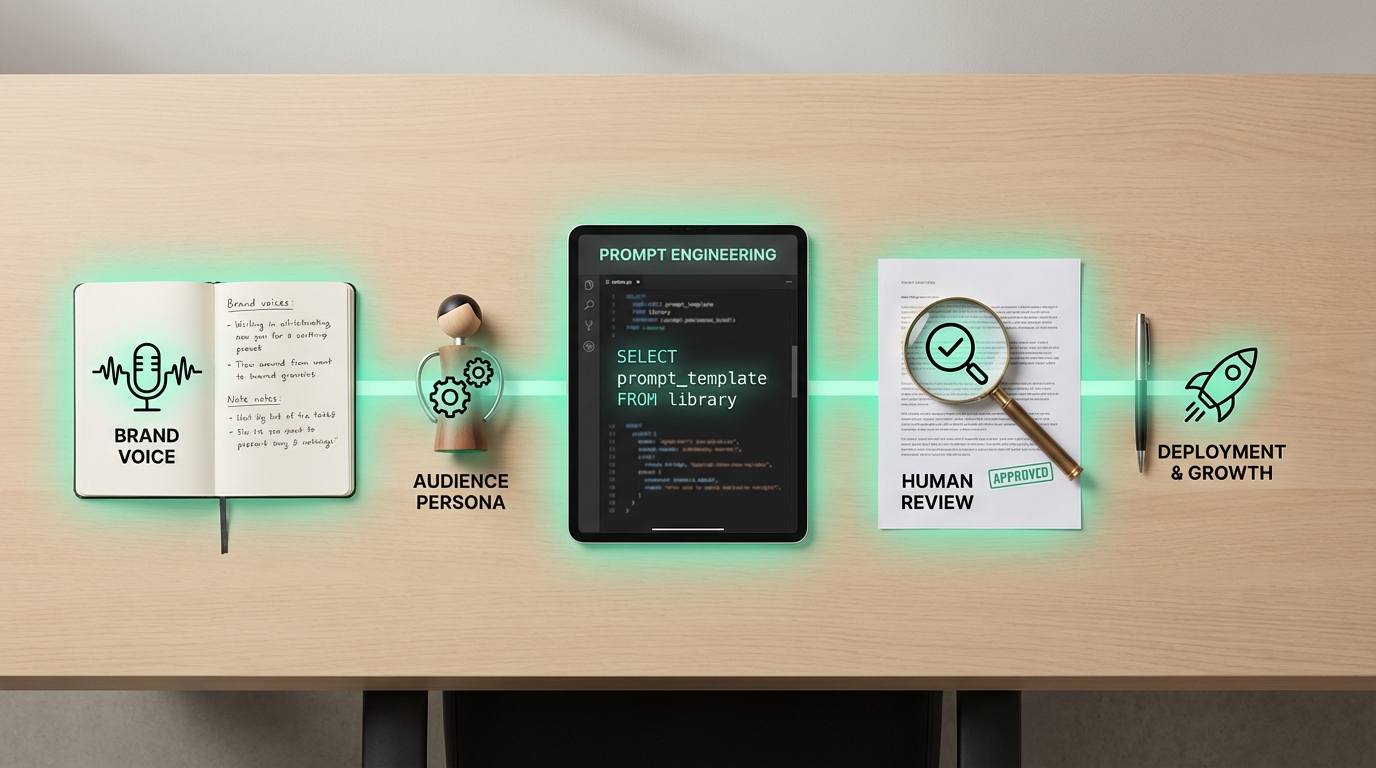
- Define Your Brand Voice: Before you write a single prompt, document your brand’s personality. Is it witty, authoritative, empathetic, or disruptive? What are your core values? What kind of language do you use (and avoid)? This isn’t just a marketing exercise; it’s the foundation of your AI’s instructions.
- Develop Detailed Audience Personas: Who are you talking to? Go beyond demographics. What are their biggest professional challenges? What content do they love? What are their goals? Create a persona for your effective UK customer. (Spoiler: it’s simpler than you think). This ensures the AI is writing for a person, not a void.
- Create a ‘Brand Bible’ for Your AI: Consolidate your brand voice, audience personas, key terminology, and company-specific information into a single reference document. You can then feed this document or key excerpts into advanced AI models to provide essential context for every content request. This “bible” becomes your AI’s single source of truth about your brand.
- Master Prompt Engineering: Move beyond simple commands. A great prompt includes:
- Role: ‘Act as an expert UK social media strategist.’
- Task: ‘Write a LinkedIn post…’
- Context: ‘…for our target audience of UK-based SME owners in the retail sector.’
- Tone: ‘…using our brand voice, which is encouraging and pragmatic.’
- Format: ‘…include a short bulleted list, a question to drive comments, and three relevant hashtags.’
- Implement a Rigorous Human-in-the-Loop Process: The final, crucial step is human editing. The AI generates the first draft (80% of the work). A human then reviews, refines, and personalises it (the final 20%). This involves checking for accuracy, improving flow, injecting personality, and ensuring the content perfectly aligns with the strategic goal.
Beyond Single Posts: Building an AI Content Strategy for the UK Market
True success with AI comes from a cohesive ai content strategy uk, not just a series of disconnected posts. The ‘Strategic Disconnect Gap’ is one of the most common reasons for failure. Data from the Federation of Small Businesses (FSB) (2023) shows that 25% of UK small businesses struggle to adopt new technology due to a lack of time. This often leads to a reactive, tactical approach to AI-just getting posts out-instead of a strategic one.
An effective strategy begins with content pillars: 3-5 core themes your brand will consistently talk about. These pillars should be the intersection of your expertise and your audience’s interests. From there, you can use simple frameworks like the 5-3-2 rule (5 parts curated content, 3 parts original content, 2 parts personal/fun content) to ensure a balanced and engaging feed.
The financial stakes are significant. Research from Statista (2025) projects that social media ad spending in the UK will continue its steep climb. Without a strategy, you’re wasting that investment.
However, building and executing this strategy manually is the very time-sink businesses are trying to avoid. This is where strategic automation becomes essential. At Social Media HQ, we’ve developed a fully automated social media system that goes beyond simple post generation. It learns your brand, defines your strategy, creates brand-aligned content pillars, and runs your campaigns, turning your AI from a simple writing assistant into a complete strategic marketing engine.
Frequently Asked Questions
What is ai content engagement?
AI content engagement refers to the measurable interactions audiences have with content created or assisted by artificial intelligence. This includes likes, comments, shares, and clicks. High engagement indicates the content is resonant and valuable to the target audience, moving beyond simple visibility. This is a key metric for determining content effectiveness and Return on Investment (ROI).
Why is my content not engaging?
Your content is likely not engaging because it lacks a distinct brand voice, a clear strategy, or fails to address your audience’s specific needs. Other common reasons include sounding too robotic, not being on the right platform for your audience, or simply publishing and forgetting without encouraging conversation. A full diagnostic is needed to pinpoint the exact cause for your brand.
What is the 5-3-2 rule for social media?
The 5-3-2 rule is a content curation guideline for social media posting. For every 10 posts, the recommendation is that 5 should be curated content from others in your industry, 3 should be your own original (non-promotional) content, and 2 should be personal or fun posts to humanise your brand. This ratio helps balance promotion with providing value.
What is the 5-3-1 rule on Instagram?
The 5-3-1 rule on Instagram is an engagement strategy, not a content rule. It suggests that to grow your network, you should ‘like’ 5 photos, leave 3 genuine comments, and gain 1 new follower within your target niche on a consistent basis. This proactive method aims to build community through outreach rather than just passively posting content.
What are the 5 C’s of content?
The 5 C’s of content are: Clear, Concise, Compelling, Credible, and Consistent. ‘Clear’ means it’s easy to understand. ‘Concise’ respects the reader’s time. ‘Compelling’ grabs attention. ‘Credible’ is trustworthy and backed by evidence. ‘Consistent’ aligns with your brand voice and publishing schedule. Adhering to these principles typically improves overall content quality and performance.
What are the 3 C’s of engagement?
The 3 C’s of engagement are typically Conversation, Community, and Connection. ‘Conversation’ means creating two-way dialogue instead of one-way broadcasting. ‘Community’ involves fostering a sense of belonging and shared identity among your followers. ‘Connection’ is about building a genuine, often emotional, link between your audience and your brand. These are the core goals of a strong engagement strategy.
What is the 3-3-3 rule in marketing?
The 3-3-3 rule suggests you have three seconds to grab a user’s attention, 30 seconds to engage them, and three minutes to convert them. This framework highlights the need for a strong initial hook (e.g., a powerful headline or image), followed by valuable information and a clear call-to-action, all within a very short user journey. It emphasizes the importance of immediate impact.
What is the 5-5-5 rule for social media?
The 5-5-5 rule for social media is an engagement-boosting technique. It involves spending 5 minutes engaging with your followers’ content, 5 minutes engaging with content from accounts you follow, and 5 minutes engaging with new accounts in your target niche. This 15-minute daily habit helps increase your visibility and build reciprocal relationships on the platform.
What type of person avoids social media?
People who avoid social media often prioritise privacy, wish to reduce digital distractions, or are concerned about the mental health impacts of comparison culture. This group can range from older individuals less familiar with the platforms to younger generations experiencing digital fatigue. They are sometimes referred to as ‘digital minimalists’ or simply private individuals who prefer other forms of communication.
How long does it take to get 10,000 followers?
There is no set timeline; it can take anywhere from a few months to several years to get 10,000 followers. Growth depends on factors like content quality, posting consistency, niche competition, and engagement strategy. While viral content can accelerate this process dramatically, sustainable, organic growth typically requires a long-term effort and a solid, well-executed strategy.
Important Considerations
Generative AI is a rapidly evolving field. The capabilities and limitations of models change frequently. This guide is based on the state of AI as of early 2026, and insights from the Stanford University Human-Centered AI (HAI) annual report (2025) confirm this rapid pace. While the strategic principles are timeless, the specific technical constraints of AI will shift, requiring ongoing adaptation of your tactics.
While this guide focuses on improving AI-assisted content, it is not the only path. Alternative approaches include fully manual content creation by an in-house team, which offers maximum control but is time-intensive and costly. Another option is hiring freelance writers or a marketing agency, which provides specialised expertise but at a higher financial cost and with potentially less direct brand control.
If your business operates in a highly regulated industry (e.g., finance, legal), has a very nuanced brand voice, or if this diagnostic reveals deep-seated strategic issues beyond content, consulting with a specialised marketing strategist is recommended. We believe AI is a powerful tool for augmenting human expertise; it cannot replace foundational business or brand strategy.
Stop Tinkering, Start Strategising
Achieving meaningful ai content engagement is less about the sophistication of your AI tool and more about the quality of your human-led strategy. By diagnosing issues like a generic voice, a lack of strategic direction, and a disconnect from your UK audience, you can begin to fix the process. The solution is to humanise your outputs, build a cohesive plan, and transform your AI from a simple writer into a strategic partner. This is how you generate a real return on your technology investment.
For UK business owners who need to improve ai content without sacrificing more time, the next logical step is strategic automation. Social Media HQ provides a fully automated social media system that builds your brand strategy, generates brand-aligned content, and runs campaigns on autopilot. Ready to see how it works? Start your free 7-day trial.
References
- Federation of Small Businesses (FSB) – 2023 Report. Found that 25% of UK small businesses find adopting new technology challenging due to a lack of time.
- Stanford University Human-Centered AI (HAI) – 2025 Annual Report. Tracks the rapid technical progress and economic impact of AI, highlighting its increasing integration into business processes.
- UK Government – Government Strategy Paper. Outlines the UK’s 10-year national strategy to support the transition to an AI-enabled economy across all sectors.
- Pew Research Center – 2024 Demographic Fact Sheet. Provides data on social media platform adoption rates by age, showing which platforms dominate specific demographics.
- Statista – 2025 Market Forecast Data. Projects that social media advertising spending in the United Kingdom will continue to grow significantly.
- Wazoplus – 2024 Article Analysis. This analysis points to a lack of a clear content strategy and failure to create conversation starters as key reasons for low engagement.
- Edify Content – 2023 Blog Post. Discusses the ‘paradox of engagement,’ noting that many audience members consume content silently and that consistent, valuable content builds trust even without visible metrics.
CONCLUSION
Stop Tinkering, Start Strategising
In summary, ai content engagement hinges not on the complexity of the AI tool, but on the quality and depth of the human-led strategy behind it. By diagnosing core problems such as a generic brand voice, the absence of a clear strategic direction, and a fundamental disconnect from your UK audience’s needs, you can shift from fixing posts to fixing the process. The path forward involves humanising your AI outputs, building a cohesive content plan, and elevating your AI from a simple content generator to a valuable strategic partner.
For UK business owners who need to improve ai content without dedicating more precious hours, the logical next step is strategic automation. Social Media HQ offers a fully automated social media system designed to build your brand