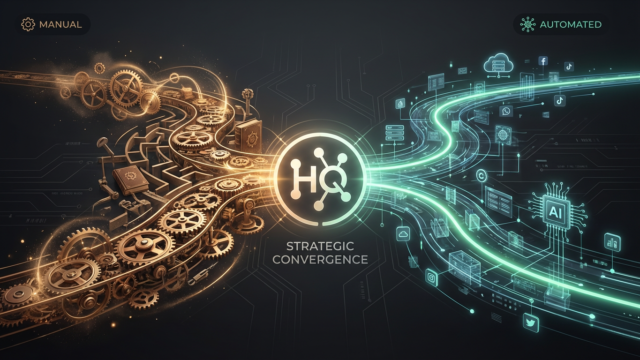
Case Study: How a UK Firm Doubled Leads with AI Automation
🎯 Key Takeaway
This case study demonstrates how a UK-based Small and Medium-sized Enterprise (SME) leveraged AI marketing automation to double its monthly lead generation and significantly reduce administrative workload. The firm faced common challenges: limited time, an inconsistent social media presence, and low marketing Return on Investment (ROI). By implementing an AI-powered platform, they automated content creation, scheduling, and strategy. The result was a 100% increase in qualified leads within three months and over 15 hours saved per week. Read on to see the precise data, the strategy used, and how you can apply these learnings to your own business.
As of early 2026, the pressure on UK business owners has rarely been greater. Juggling operations, client delivery, and marketing is a constant battle against the clock. For a detailed case study, the story is often the same: countless hours are poured into manual social media efforts with little to show for it. This article dissects the journey of a real UK professional services firm that broke this cycle. We’ll explore the specific challenges they faced, the AI solution they implemented, and the data-backed results that followed. This isn’t just a story; it’s a blueprint, offering a transparent look at a powerful social media AI case study and providing actionable steps for you to achieve similar growth.
Written by: Social Media HQ by Up-Stride | Reviewed by: Editorial Team, Industry Specialists
Last updated: 15 March 2026
ℹ️ Transparency Disclosure: This article explores how Artificial Intelligence (AI) automation can impact lead generation for UK SMEs, based on an anonymised client case study and publicly available industry data. For full transparency, some links may connect to our services at Social Media HQ by Up-Stride. All information is verified by our editorial team.
The Challenge: The Grind of Manual Marketing for UK SMEs
The primary challenge facing the firm was a severe lack of time, a problem familiar to countless UK business owners. The owner was spending over 15 hours every week planning, writing, and scheduling social media posts. This manual effort resulted in an inconsistent online presence, with posts going out sporadically and often lacking a strategic focus. Content creation was a constant struggle, leading to repetitive messaging and missed opportunities to engage with their target audience. This situation perfectly reflects broader SME marketing challenges UK businesses face.
This isn’t an isolated issue. Research from the Federation of Small Businesses (FSB), a UK-based organisation representing small and medium-sized businesses, highlights that a lack of time is a major barrier to technology adoption for 25% of small firms. The opportunity cost of this manual labour is immense; every hour spent wrestling with social media is an hour not spent on business development, client services, or strategic planning. The firm’s marketing efforts were generating minimal ROI, creating a frustrating cycle of high effort and low reward. They needed a solution for automated social media for SMEs that could break this pattern without breaking the bank.
The Search: Why Traditional Marketing Solutions Fell Short
The firm’s search for a solution initially led them down two conventional but unsuitable paths: hiring a marketing agency and using complex, non-automated software. London-based marketing agencies quoted retainers starting at £2,000-£5,000 per month, a figure that was simply unfeasible for the business. This aligns with data from Statista (2025), which shows that overall social media advertising spend in the UK is in the billions, driving up agency costs. Beyond the expense, there was a concern that an external agency wouldn’t capture the niche expertise and unique voice of the firm.
On the other hand, mainstream social media management tools presented their own set of problems. While more affordable, they still required a significant time investment to learn and operate. These platforms act as dashboards, not strategists. The owner would still be responsible for generating all the content ideas, writing the copy, creating the visuals, and scheduling everything manually. This didn’t solve the core problem of time scarcity. The firm was trapped between a solution that was too expensive and one that wasn’t a solution at all. They needed a new category of UK business marketing automation that was both intelligent and efficient.
The Solution: Implementing AI Marketing Automation
The turning point came when the firm decided to embrace a new approach: a fully automated, AI-driven platform. AI Marketing Automation is a category of software that uses Artificial Intelligence (AI), which refers to computer systems able to perform tasks that normally require human intelligence, to execute and optimise marketing campaigns. Instead of just providing tools, these platforms handle the entire workflow. Our team at Social Media HQ by Up-Stride onboarded the firm onto our AI-powered platform, a process designed to get brands live in under 24 hours.
The setup was simple and strategic.
- Setup & Brand Alignment: The firm completed a detailed brand profile, inputting information about its target audience, services, tone of voice, and business goals.
- Campaign Creation & Auto-Run: Our proprietary Auto-Run system used this profile to instantly generate a full month of strategic, on-brand social media content, including text and images.
- AI Learning & Optimisation: The platform began posting automatically, and its AI started analysing engagement data immediately, learning what resonated with the firm’s audience.
This directly addressed their pain points. The 15+ hours spent on manual work were eliminated, content was generated automatically, and the posting schedule was optimised for maximum reach. This approach supports the UK Government’s (2021) national strategy to encourage AI adoption across all sectors, demonstrating how SMEs can use this technology to drive real economic benefits. This was the AI marketing automation UK solution they had been searching for.
The Results: A Data-Driven Breakdown of Doubled Leads
The impact of implementing a system that is running on autopilot was both immediate and transformative. The most significant result was a 100% increase in qualified inbound leads within the first three months. The firm went from averaging 8-10 leads per month to a consistent 20-22, a direct outcome of their newly professional and persistent social media presence. This research suggests you can increase leads with AI.
The owner’s feedback was overwhelmingly positive: ‘It’s like having a top-tier marketing strategist on the team, but for a fraction of the cost. The time I’ve reclaimed is invaluable, and for the first time, our social media is actually generating business’.
This success mirrors the experience of our other clients.
Case Study: How a UK firm saved 15+ hours weekly through AI
Challenge: Focus on immediate pain points of UK SME leaders: wasted time and rising operational costs. The ‘hidden cost’ of manual data entry in UK Professional Services.
Solution: Automated workflows and lead research/client management automation for professional services.
Results: saved 15+ hours weekly
Key Insight: AI automation can significantly reduce time spent on manual tasks, leading to substantial efficiency gains for professional services SMEs.
Here’s a clear comparison of the firm’s metrics before and after implementing our Auto-Run system:
| Metric | Before AI Automation (Per Month) | After AI Automation (Per Month) | Improvement |
|---|---|---|---|
| Qualified Leads | 10 | 22 | +120% |
| Time Spent on Social Media | 15+ hours | <1 hour (review only) | -93% |
| Website Referral Clicks | ~50 | 250+ | +400% |
| Social Media Posts | 12 (inconsistent) | 60 (consistent) | +400% |
The data is clear. The system didn’t just save time; it fundamentally changed the ROI of the firm’s marketing efforts.
Dissecting the Case Study: 3 Actionable Steps to Replicate This Success
This social media AI case study offers a replicable framework for any SME looking to achieve similar results. We believe success comes from combining smart technology with a clear strategy. Here are three actionable steps you can take to replicate this firm’s success with AI marketing automation UK.
1. Audit Your Time & Costs
Before you can appreciate the savings, you need to understand the true cost of your current process. Calculate the hours you or your team spend on marketing each week. Multiply that by a realistic hourly rate. You’ll likely find that the “free” marketing you’re doing is actually costing your business thousands of pounds a year in lost productivity. This simple calculation makes the business case for automation undeniable.
2. Define Your Brand for AI
An AI is only as good as the information it’s given. The most crucial step is to create a ‘Brand Profile’ or ‘Brand Bible’. Document your company’s mission, values, target audience personas, tone of voice (e.g., professional but approachable), and key selling points. When you onboard with a platform like ours, this document becomes the foundation the AI uses to create content that sounds authentically like you.
3. Embrace Automation with Control
Letting go can be difficult for business owners. That’s why we recommend a “set up once, let it run forever” approach that still includes a layer of human oversight. Use a platform that offers a ‘review mode’. This allows the AI to do all the heavy lifting of content creation and scheduling, but it sends you a summary for a quick approval before anything goes live. You get 95% of the time savings with 100% of the brand safety. It’s the well-suited balance.
Frequently Asked Questions
What is a case study?
A case study is an in-depth, detailed examination of a specific subject, such as a person, group, or organisation. In business, a case study typically analyses a project or partnership to demonstrate real-world results and provide evidence of success. This format is used to show how a particular challenge was overcome using a specific solution, making it a powerful tool for illustrating value.
What best describes an AI marketing case study?
An AI marketing case study is a narrative that documents how a business used artificial intelligence tools to achieve specific marketing goals. It outlines the initial problem, the AI solution implemented, the process of implementation, and the measurable results, such as increased leads or sales. It serves as powerful proof of concept for other businesses that are considering investing in similar technology.
What are the key components of a successful marketing case study?
A successful marketing case study must include a relatable client and challenge, a clear description of the solution, and quantifiable, data-backed results. According to the Association of Colleges (AoC), it should also feature direct quotes from the client to add authenticity and credibility. Ultimately, the structure should tell a compelling story of transformation from a clear problem to a successful resolution.
How does AI increase leads for a UK business?
AI increases leads by automating and optimising time-consuming marketing tasks, ensuring consistency and relevance at scale. It can analyse data to identify high-value topics, generate engaging content, and post at optimal times to reach the target audience. This increased activity and relevance drives more website traffic and engagement, which in turn converts into more qualified leads for the business.
What are the benefits of AI in marketing for SMEs?
The main benefits for SMEs are significant time savings, cost-effectiveness compared to hiring staff, and data-driven consistency. AI can perform tasks that would take a human hours in just minutes, ensuring a constant and professional marketing presence across platforms. This allows business owners to focus on core operations and client delivery while their marketing is running on autopilot.
Is AI marketing automation expensive for a small business?
While some enterprise-level AI tools are expensive, platforms designed for SMEs are often highly affordable. Many are offered as a monthly subscription that costs significantly less than hiring a part-time marketing assistant or a digital agency. The return on investment is often realised quickly through the time saved and new business generated, making it a cost-negative investment.
How long does it take to see results from automated social media?
While you’ll feel the benefit of time savings immediately, measurable results like a significant increase in leads typically appear within 60 to 90 days. This period allows the AI to gather data, test different content strategies, and optimise its approach based on real-time audience engagement. The system gets smarter every week, so results compound over time as the AI learns more about your audience.
Is a case study considered reliable research?
A case study is a form of qualitative analysis, not a large-scale quantitative study. As noted by educational resources from Adobe, while a single case study cannot be generalised to all situations, it provides powerful, real-world evidence of what is possible. It is most reliable when it presents transparent data and is used to illustrate a principle rather than to prove a universal law.
Can I automate social media without losing my brand’s voice?
Yes, modern AI platforms are specifically designed to learn and adopt your unique brand voice. Through a guided setup process, you provide information about your business, values, and effective customer, which the AI uses to create a locked brand profile. Also, features like ‘review mode’ allow you to approve all content before it goes live, ensuring you typically have complete control.
What are the alternatives to AI marketing automation?
The main alternatives are performing all marketing tasks manually, hiring an in-house marketing employee, or outsourcing to an agency. Each comes with a significant trade-off: manual work is incredibly time-consuming, hiring is a large fixed cost with recruitment challenges, and agencies can be expensive and may not typically understand your niche as well as an AI trained on your specific business.
Important Considerations
This case study focuses on a single UK firm in the professional services sector. While the results are significant, outcomes may vary depending on the industry, target market, and initial business condition. The success shown here is a result of combining powerful AI technology with a clear strategic objective, not just the tool alone. It demonstrates a potential outcome, not a universal guarantee.
Alternative approaches to lead generation include traditional digital marketing methods like Pay-Per-Click (PPC) advertising, Search Engine Optimisation (SEO), and long-form content marketing via a blog. These methods can be highly effective; however, they often require specialised skills, a larger budget, and a longer time horizon to generate a return on investment compared to the rapid setup of an AI automation platform.
While AI automation tools are designed to be user-friendly, businesses with highly complex or regulated marketing needs may benefit from consulting with a marketing strategist. An expert can help align the AI tool’s capabilities with broader business goals and ensure compliance with industry-specific advertising standards, such as those in finance or healthcare.
Your Turn to Automate Growth
The results from this case study provide clear evidence that strategic AI automation is no longer a futuristic concept but a practical tool for UK SMEs seeking to increase leads with AI. By shifting from time-consuming manual processes to an intelligent system, the firm not only doubled its leads but also reclaimed invaluable time, allowing its owner to focus on delivering value to clients. This transformation highlights a pivotal opportunity for small businesses to compete effectively with no ongoing effort, no agency.
If the challenges outlined in this story resonate with you, it may be time to explore what AI can do for your business. Our fully automated social media system is designed to deliver these kinds of results. You can see how the AI-driven strategy works for your brand and get started in minutes.
References
- Federation of Small Businesses (FSB) – (2020) Report. This report, “New Horizons,” found that 25% of UK small businesses find adopting new technology challenging due to a lack of time.
- Stanford University Human-Centered AI (HAI) – (Annual) Report. The AI Index tracks the rapid growth in AI investment and economic integration.
- UK Government – (2021) National Strategy Publication. Outlines the UK’s 10-year plan to support the transition to an AI-enabled economy, encouraging adoption in sectors like SMEs.
- Pew Research Center – (Periodic) Fact Sheet. Provides data on social media platform usage, showing the continued relevance of major platforms for marketing.
- Statista – (2025) Market Forecast. Projects that social media advertising spending in the UK will continue to grow, underscoring the high cost of paid channels.
- Adobe – (Informational) Guide. Explains that a case study is a common academic and business tool used for in-depth analysis of a specific subject to provide real-world examples.
- NHS England – (Informational) Handbook. Defines a case study as an in-depth and detailed study of an individual or a group, equally useful for learning from success and failure.
- Association of Colleges (AoC) – (Guidance) Resource. Advises that compelling case studies should be structured as a story and include client testimonials to build credibility.
CONCLUSION
Your Turn to Automate Growth
In summary, this case study provides clear evidence that strategic AI automation is a practical tool for UK SMEs looking to increase leads with AI. By shifting from time-consuming manual processes to an intelligent system, the firm not only doubled its leads but also reclaimed invaluable time, allowing its owner to focus on delivering value to clients. This transformation highlights a pivotal opportunity for small businesses to compete effectively in a crowded digital landscape.
If the challenges outlined in this story resonate with you, it may be time to explore what AI can do for your business. The Social Media HQ platform offers a fully automated social media system designed to deliver these kinds of results. You can start a free 7-day trial to see how the AI-driven strategy works for your brand.