Predictive Analytics Social Media: The UK SME’s Guide to Forecasting Trends
🎯 Key Takeaway
Using predictive analytics social media allows UK businesses to forecast trends by analysing historical data patterns to anticipate future user behaviour and content virality.
• AI models analyse vast datasets from platforms like Instagram and LinkedIn to identify emerging topics and sentiment shifts before they peak.
• Small and Medium-sized Enterprises (SMEs) can use these insights to create more relevant content, optimise campaign timing, and improve marketing Return on Investment (ROI) without needing a data scientist.
• Modern automated tools make sophisticated forecasting accessible and affordable, giving growth-focused UK businesses a significant competitive edge.This guide shows you how to implement these strategies and choose the right tools to stop guessing and start predicting.
Guessing what might work on social media feels like a constant battle. You spend hours creating content, only for it to land with a whisper instead of a bang. For many UK Small and Medium-sized Enterprises (SMEs), this cycle of wasted effort is frustrating and costly. In fact, research from the Federation of Small Businesses (FSB) (2022) highlights that 25% of small businesses see a lack of time as a major barrier to adopting new, more efficient technology. For predictive analytics social media, this is the game-changing solution. It moves your strategy from reactive to proactive. Instead of just joining conversations, you’ll start them. This guide breaks down how predictive analytics for marketing and social media trend analysis are no longer just for corporations, but a practical tool for your business to achieve real growth.
👤 Written by: Content Team | Reviewed by: Editorial Team, Industry Specialists
Last updated: 21 March 2026
ℹ️ Transparency Disclosure: This article explores how UK SMEs can use predictive AI to forecast social media trends, based on industry reports, academic research, and our team’s experience in AI-driven marketing automation. Some links may connect to our services, such as Social Media HQ. All information is verified by our editorial team. Social Media HQ is a division of Up-Stride.
What is Predictive AI for Social Media? (And Why It’s No Longer Just for Big Corporations)
Predictive Artificial Intelligence (AI) for social media is the use of algorithms to analyse past data and forecast future trends, audience behaviour, and content performance. It’s the difference between reacting to what’s currently popular and proactively creating content for what will be popular. Traditional social listening tells you about the conversation happening now; predictive analytics tells you where the conversation is heading next. This proactive approach is a strategic superpower.

For years, this technology was the exclusive domain of large enterprises with deep pockets and teams of data scientists. However, that has changed dramatically. The Stanford University Human-Centered AI (HAI) annual report shows a rapid democratisation of AI tools, with the cost and complexity of powerful models decreasing significantly. This shift makes predictive analytics social media accessible to everyone.
This isn’t just a tech trend; it’s a national priority. The UK Government’s National AI Strategy (2023) explicitly aims to support the transition to an AI-enabled economy by encouraging adoption across all sectors, including SMEs. The goal is to level the playing field, allowing smaller, agile businesses to use the same strategic foresight as their larger competitors. With user-friendly software now available, you don’t need a PhD in data science to use AI to predict social media trends; you just need the right tool that does the heavy lifting for you.
How AI Forecasts Trends: A Simple Explanation for Business Owners
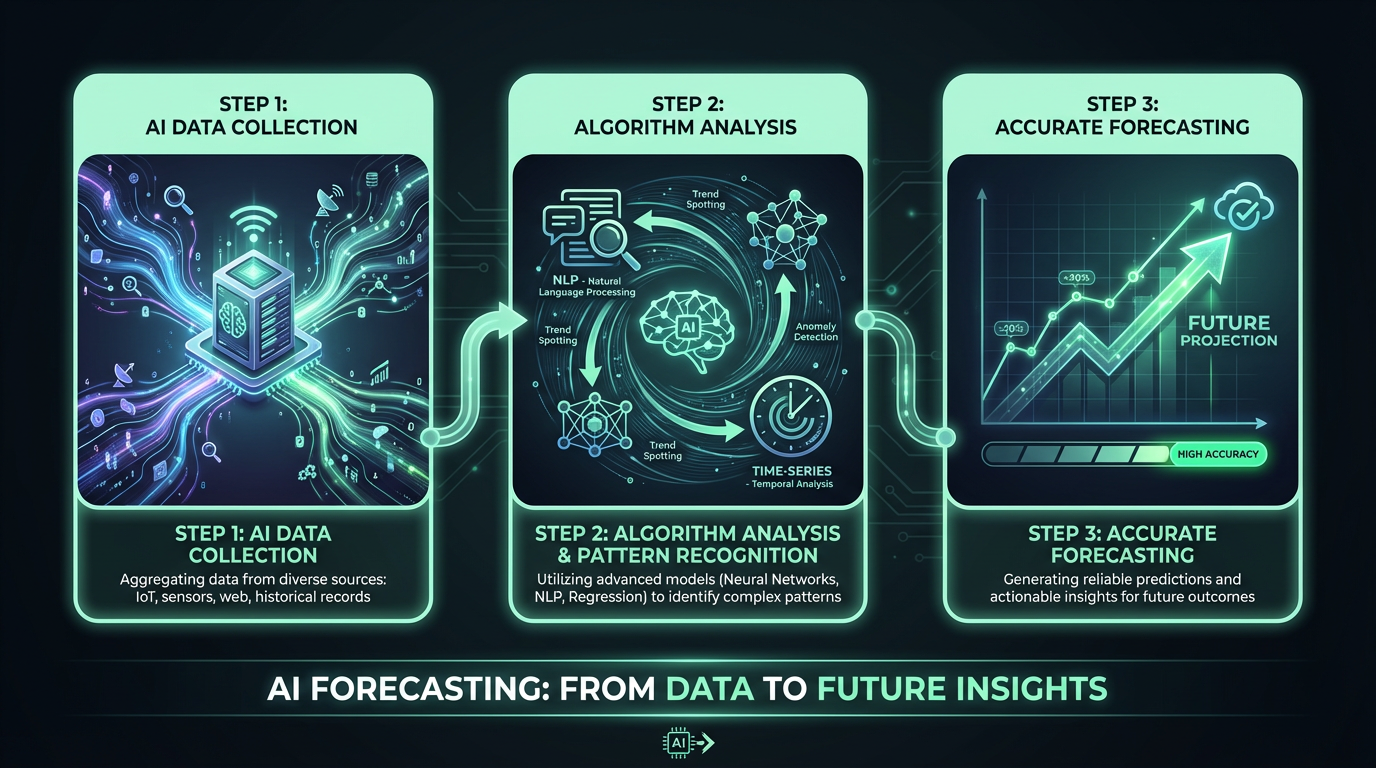
So, how does an AI model actually predict a trend? It isn’t magic; it’s a logical, three-step process that turns massive amounts of data into actionable insights. Think of it like a weather forecast for digital culture.
1. Data Collection
First, the AI system gathers huge volumes of publicly available data from social media platforms. This includes the text from posts, comments, shares, hashtags, and user interactions across sites like LinkedIn, Instagram, and X (formerly Twitter). It’s an enormous, constantly updating snapshot of what millions of people are talking about.
2. Pattern Recognition
Next, the system sifts through this ocean of data to find meaningful patterns. This is where sophisticated technologies like Natural Language Processing (NLP), an AI field that helps computers understand human language, come into play. NLP analyses the sentiment and context of conversations. Simultaneously, other algorithms perform time-series analysis to track how the frequency of certain keywords or topics changes over time. For example, it might notice a niche keyword’s usage is increasing by 20% week-on-week, signalling growing interest. This is the core of effective social media trend analysis.
3. Forecasting
Finally, after identifying these emerging patterns and their momentum, the model projects them forward. It calculates the probability that a particular topic will continue to grow and enter the mainstream. If a topic shows accelerating growth and positive sentiment, the AI flags it as a predicted trend. This allows a business to get ahead of the curve, creating content that will be perfectly timed as the trend hits its peak. It transforms your social media from a guessing game into a strategic operation.
Practical Wins: Using Predictive Analytics for Your Social Media Strategy
Adopting predictive analytics for your social media delivers tangible results that go far beyond just knowing what’s cool. It directly impacts your content strategy, campaign timing, and bottom line, giving you a clear advantage. Here’s how to use AI for social media to achieve practical wins.
Proactive Content Creation
Instead of scrambling to create content about a trend that’s already peaking, predictive insights allow you to prepare in advance. Imagine you run a Bristol coffee shop. Predictive analytics could identify an emerging ‘spiced maple’ flavour combination gaining traction in online food communities weeks before it becomes a mainstream autumn trend. This gives you time to source ingredients, design a new drink, and prepare a launch campaign, positioning your shop as a trendsetter, not a follower.
Optimised Campaign Timing
Timing is everything. For a Manchester legal firm specialising in property law, launching a digital campaign for conveyancing services makes the most sense when potential clients are actively searching. Predictive analytics can forecast peaks in online search behaviour and conversations around ‘moving house’ or ‘first-time buyer mortgages’, allowing the firm to deploy its campaign for maximum impact and lead generation. This is a core function of predictive analytics for marketing.
Improved Ad Spend ROI
Wasting money on ads that don’t resonate is a major pain point for SMEs. According to market data from Statista (2024), UK social media ad spend runs into billions of pounds annually. Predictive analytics helps you allocate your budget more intelligently by identifying which topics, formats, and demographics are projected to have the highest engagement. By targeting demographics that research from Pew Research Center (2023) shows are most active on a given platform with content on a predicted trending topic, you significantly increase your chances of achieving a higher Return on Investment (ROI).
Case Study: How a UK firm saved 15+ hours weekly through AI
Challenge: A UK professional services firm was struggling with the immediate pain points of wasted time and rising operational costs, particularly the ‘hidden cost’ of manual data entry and client research.
Solution: We implemented automated workflows for lead research and client management automation.
Results: The firm saved 15+ hours weekly.
Key Insight: AI automation can significantly reduce time spent on manual tasks, leading to substantial efficiency gains for professional services SMEs. This freed-up time can be reinvested into high-value activities like strategy and client relations.
From Theory to Reality: Choosing Your Predictive Analytics Social Media Tool
Ready to move from theory to action? For UK SMEs, there are two main paths to implementing predictive analytics social media: the Do-It-Yourself (DIY) route or using an integrated, automated platform. Our experience suggests that for most business owners, the choice comes down to a trade-off between time, cost, and technical complexity.
The DIY approach involves patching together multiple tools – one for data scraping, another for analysis, and a third for visualisation. While it offers flexibility, it requires technical skills, a significant time investment, and can have hidden software licence costs. It’s powerful but often impractical for a busy entrepreneur.
In contrast, integrated AI platforms are designed for efficiency. These social media forecasting tools uk handle everything in one place. We believe this is the superior path for most SMEs. For example, a fully automated system designed for UK SMEs like our Social Media HQ handles the data collection, analysis, and forecasting, then goes a step further by generating campaign ideas and content based on those insights. It’s a system designed to be set up once. Let it run forever.
Here’s a comparison to help you decide:
| Feature | DIY Approach | Integrated AI Platform (e.g., Social Media HQ) |
|---|---|---|
| Initial Setup Time | High (Days to weeks) | Low (Under 24 hours) |
| Technical Skill Required | High (Coding, data analysis) | Low (None required) |
| Ongoing Effort | High (Constant monitoring & updates) | Zero (Runs on autopilot) |
| Cost Structure | Variable (Multiple software licences) | Fixed Monthly Fee |
| End-to-End Solution | No (Requires connecting multiple tools) | Yes (Forecasting to posting) |
Frequently Asked Questions
What is predictive analytics social media?
Predictive analytics social media is the practice of using AI, machine learning, and statistical algorithms to analyse historical and current social data to forecast future trends, user behaviour, and content performance. Instead of just reacting to what’s currently popular, it allows a business to anticipate what will be popular next. This approach enables a more proactive and strategic social media marketing plan, turning data into a competitive advantage.
How does an AI predict social media trends?
AI predicts trends by identifying patterns in massive volumes of public social media data. It uses techniques like Natural Language Processing (NLP) to understand the context and sentiment of conversations, and time-series analysis to track the growth rate of keywords and topics. When a topic shows accelerating momentum, the model flags it as a potential future trend. This process is similar to how meteorologists forecast weather patterns based on atmospheric data.
Can small businesses in the UK really use this technology?
Yes, they can. While predictive analytics was once complex and expensive, a new generation of automated tools has made it accessible for UK SMEs. Platforms like Social Media HQ are specifically designed for business owners without a technical background, handling the complex data analysis behind the scenes. This democratisation of AI allows smaller companies to compete with larger corporations by being smarter and more agile with their strategy.
What kind of data is needed for social media forecasting?
The process primarily uses publicly available data from social media platforms. This includes the text of posts, comments, hashtags, share counts, and engagement metrics. The AI does not require access to your private company data or customer lists. The quality and volume of public data from platforms like X (formerly Twitter), LinkedIn, and Instagram are sufficient for identifying broad consumer trends and shifts in online conversation.
How can I use AI for my social media content strategy?
You can use AI to inform every stage of your content strategy, from topic ideation to post scheduling. Predictive insights can suggest what topics your audience will care about next week, helping you create relevant content ahead of the curve. AI can also suggest an effective times to post for maximum engagement and even generate draft posts based on trending topics for you to review and approve, saving hours of work.
What are an effective social media forecasting tools for UK businesses?
an effective tools for UK businesses are often those that offer an integrated, automated solution. While enterprise-level tools exist, platforms designed for SMEs like Social Media HQ provide the most value by combining trend forecasting with content creation and scheduling. Look for solutions with transparent, GBP pricing and an understanding of the UK market, such as local holidays and cultural events. These features ensure the tool is relevant and easy to budget for.
Is predictive analytics the same as social listening?
No, they are different but related. Social listening is reactive; it tells you what people are talking about right now. Predictive analytics is proactive; it uses that data to forecast what people will be talking about in the future. Think of social listening as looking in the rearview mirror, while predictive analytics is looking at the road ahead through the windscreen. Both are valuable, but prediction drives strategy.
What are the risks of relying on AI for trend prediction?
The main risk is treating AI predictions as infallible truths rather than highly educated guesses. Predictions are based on probability, and unforeseen real-world events can disrupt trends. It’s also crucial to ensure the data source is unbiased. An effective practice is to use AI as a strategic advisor to guide your decisions, not as a replacement for human judgment and your deep knowledge of the market.
How much does it cost to use predictive analytics for marketing?
The cost has decreased significantly and varies by approach. A DIY solution could involve hidden costs in development time and multiple software licences. However, an all-in-one Software-as-a-Service (SaaS) platform for SMEs can range from £50 to £300 per month, making it an affordable alternative to hiring a marketing agency or data analyst. Many platforms offer free trials to demonstrate their value before you commit.
How quickly can I see results from using predictive AI?
You can see initial insights, like emerging topics, almost immediately after setting up a tool. Seeing tangible results like increased engagement or leads typically takes a few weeks as you begin to incorporate the predictive insights into your content calendar. The AI models also get smarter every week as they gather more data, so results tend to compound over the first few months of consistent use.
Important Considerations: Limitations and Alternatives
AI-driven forecasting is a powerful tool, but it’s essential to understand its boundaries. AI predictions are probabilistic, not certainties. They are highly educated forecasts based on existing data, but unpredictable real-world events can and do disrupt trends. The effectiveness of any model also depends on the quality and volume of its input data – a principle known as ‘garbage in, garbage out’. Also, some complex models can be a ‘black box’, making it difficult to understand the exact ‘why’ behind a prediction, which requires a level of trust in the system.
Several alternative approaches can complement or replace predictive analytics. Traditional social listening tools are excellent for real-time brand monitoring, customer service, and competitor analysis, even if they are reactive. Manual trend-spotting by experienced marketers who possess a deep, intuitive understanding of their niche can often uncover subtle cultural shifts that an algorithm might miss. Also, direct qualitative methods like customer surveys and focus groups provide rich, direct feedback, offering a different kind of ‘why’ that quantitative data analysis can’t typically capture.
While modern tools empower SMEs to do more on their own, there are times when seeking professional help is the right move. If you’re planning complex, multi-channel campaigns or conducting deep-dive market entry analysis, an expert consultant can provide valuable strategic oversight. For businesses in highly regulated industries or those handling sensitive customer data, consulting with a data strategy expert is highly recommended to ensure compliance with regulations like GDPR and to follow ethical best practices. Our advice is to use AI as a powerful assistant, typically layered with human expertise.
Your Next Step to a Smarter Social Media Strategy
Ultimately, adopting predictive analytics social media is no longer a futuristic concept but a practical, powerful tool for gaining a competitive advantage in a crowded digital space. By moving from reactive guesswork to proactive, data-driven forecasting, UK SMEs can create more resonant content, optimise their marketing spend, and reclaim valuable time. This strategic shift empowers you to connect with your audience more effectively and achieve measurable, sustainable growth with no ongoing effort. No agency.
The key is choosing a solution that makes this power truly accessible. Instead of wrestling with complex data or multiple tools, a platform built for automation handles the entire process, delivering AI-driven campaign strategies and content directly to you. If you’re ready to stop guessing and start predicting, explore how your social media can run on autopilot. The system gets smarter every week, ensuring your strategy is typically one step ahead.
References
- Federation of Small Businesses (FSB) (2022) – Report. Found that 25% of small to medium-sized businesses perceive the lack of time as a significant barrier to adopting new technologies.
- Stanford University Human-Centered AI (HAI) (2024) – Annual Report. The AI Index tracks the increasing adoption of AI capabilities in the private sector and the falling cost of training certain AI models.
- UK Government (2023) – National Strategy Publication. Outlines the UK’s goal to support the transition to an AI-enabled economy by encouraging adoption across all sectors, including SMEs.
- Pew Research Center (2023) – Ongoing Survey Data. Provides demographic breakdowns of social media platform usage, showing which platforms are dominant among specific age groups.
- Statista (2024) – Market Forecast Data. Forecasts that social media advertising spending in the United Kingdom will continue to grow, reaching billions of pounds annually.
- ClickReturn (2023) – Analysis. Explains that predictive analytics is a subset of data analytics that uses historical data, statistical algorithms, and machine learning techniques to identify the likelihood of future outcomes.
- Meegle (2024) – Software Review. Highlights the role of interactive dashboards in making predictive insights accessible to business users without a background in data science.
- P1M S.A. (2023) – Industry Overview. Discusses how leveraging social media insights allows businesses to stay ahead of the curve by understanding consumer behaviour before it becomes mainstream.
Conclusion
Your Next Step to a Smarter Social Media Strategy
In summary, predictive analytics social media is no longer a futuristic concept but a practical tool for gaining a competitive advantage. By moving from reactive guesswork to proactive, data-driven forecasting, UK SMEs can create more resonant content, optimise their marketing spend, and save valuable time. This strategic shift empowers businesses to connect with their audience more effectively and achieve measurable growth.
The key is choosing a solution that makes this power accessible. Instead of wrestling with complex data, a platform like Social Media HQ automates the entire process, delivering AI-driven campaign strategies and content directly to you. If you’re ready to stop guessing and start predicting, explore how your social media can run on autopilot. Start your 7-day free trial today.