
10 Essential AI Prompts for B2B: A Strategic Guide for UK SMEs
🎯 Key Takeaway
an effective AI prompts for B2B social media go beyond simple commands, incorporating persona, context, tone, and goals to generate strategic content. For UK Small and Medium-sized Enterprises (SMEs), this means crafting prompts that produce nuanced, platform-specific posts which resonate with a professional audience and drive measurable results. Successful prompting turns Artificial Intelligence (AI) from a simple content generator into a powerful strategic partner. This guide provides 10 actionable prompts to transform your B2B social media from manual effort to intelligent execution.
As of Q1 2026, many UK businesses are experimenting with AI, but few are unlocking its true strategic power. The internet is flooded with generic, uninspired content that fails to connect with a discerning business-to-business audience. For AI prompts for B2B, the quality of your input directly dictates the quality of your output. For time-poor SME leaders, this presents a frustrating challenge. Research from the Federation of Small Businesses (FSB) (2023) highlights that 25% of small businesses identify a lack of time as a key barrier to adopting new technologies.
We believe the solution isn’t just using AI, but using it intelligently. This guide moves beyond basic questions to provide 10 specific, actionable prompts. We’ll also introduce a framework for thinking strategically about generative AI for social media content, helping you create posts that build authority and drive growth.
👤 Written by: Social Media HQ Content Team
Reviewed by: Social Media HQ Editorial Team, Experts in AI-driven marketing automation for UK SMEs
Last updated: 15 March 2026
ℹ️ Transparency Disclosure: This article explores strategic AI prompting for B2B social media based on extensive industry analysis and platform best practices. Some links may connect to our services, such as Social Media HQ. All information is verified by our editorial team to ensure accuracy and relevance for UK businesses.
The Anatomy of a Powerful B2B Prompt: The 5 Key Ingredients
A powerful prompt is the difference between generic fluff and strategically valuable content. In our experience, the most effective prompts follow a five-part structure that gives the AI clear, unambiguous direction. This is the foundation of effective AI prompt engineering for marketing UK. We recommend this five-part structure, which you can remember with the acronym R-T-C-F-C.
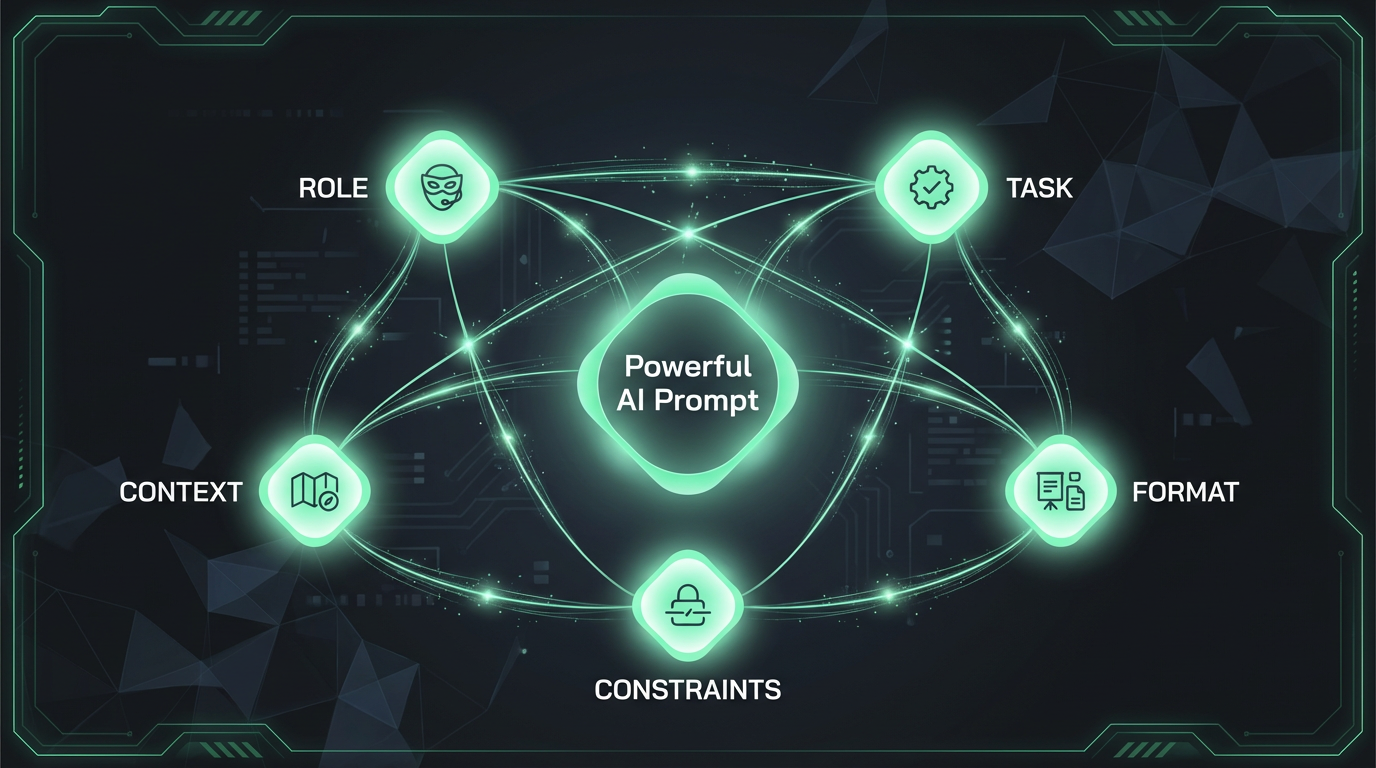
- Role: Tell the AI who to be. Assigning a role like ‘Act as a seasoned B2B marketing strategist for UK tech startups’ immediately frames the context and expertise level.
- Task: State exactly what you want the AI to do. Be specific. Instead of ‘write a post’, use ‘Draft three engaging LinkedIn post variations’.
- Context: Provide the necessary background. This is where you include your target audience, their pain points, your brand’s unique selling proposition (USP), and the overall goal of the content.
- Format: Define the desired output structure. Should it be a bulleted list, a 300-word article, a five-part Twitter thread, or a table?
- Constraints: Set the boundaries. Specify the tone of voice (e.g., ‘professional yet approachable’), words to avoid, required keywords, and post length.
This framework is crucial for overcoming the ‘brand voice gap’ that often plagues generative AI for social media content. The rapid advancement of AI models, as tracked in the Stanford University HAI (2024) AI Index Report, means these tools are more capable than ever, but they still need precise human guidance to shine. By providing these five ingredients, you steer the AI away from generic statements and towards creating content that sounds like it truly comes from your brand.
Foundational AI Prompts for B2B Brand & Audience Definition
Before you can create compelling content, the AI needs to understand who you are and who you’re talking to. In our experience, starting with these foundational AI prompts for B2B is the most effective way to ensure all future content is consistent and targeted. Think of this as the initial briefing for your new AI team member.
Prompt 1: Develop Your Brand Voice
This prompt feeds the AI your core identity, teaching it to write in your specific style.
Prompt: “Act as a brand strategist. Analyse the following text from my company’s ‘About Us’ page and mission statement: [Paste 2-3 paragraphs of your best company copy here]. Based on this, define our brand voice, including key characteristics, tone (e.g., authoritative, innovative, approachable), and a list of 5 ‘words to use’ and 5 ‘words to avoid’.”
Prompt 2: Create a Detailed Customer Persona
You can’t create resonant content without a deep understanding of your audience. This prompt builds that picture.
Prompt: “Create a detailed customer persona for a UK-based ‘Operations Director at a mid-sized manufacturing firm (50-250 employees)’. Include their primary job responsibilities, key challenges (e.g., rising operational costs, supply chain disruption, sustainability targets), professional goals, and what they look for in a new technology partner. Give this persona a name.”
Prompt 3: Establish Core Content Pillars
This prompt helps you define the key themes your brand will own, ensuring your content strategy is focused and consistent.
Prompt: “Based on our brand voice (from Prompt 1) and our target persona (from Prompt 2), generate 4 core content pillars for our social media. For each pillar, provide a brief description and 3 example topic ideas. The pillars should position us as an expert in solving our persona’s key challenges.”
Content Ideation & Creation Prompts (Prompts 4-6)
Once the AI understands your brand and audience, you can move to generating actual content ideas and drafts. These prompts bridge the gap between strategy and execution, transforming your defined pillars into tangible B2B social media content ideas. This is where you can start leveraging chatgpt prompts B2B marketing to build a real content pipeline.

Prompt 4: Generate a Weekly Content Calendar
Turn your content pillars into a practical, week-long plan. This organises your efforts and ensures a consistent presence.
Prompt: “Act as a B2B social media manager. Using the 4 content pillars we established [list your pillars here], create a 5-day content calendar for LinkedIn. Assign one post per day, ensuring a mix of formats (e.g., text-only post, image post, short video idea, link to a blog). For each day, provide the content pillar, a post concept, and a suggested call-to-action.”
Prompt 5: Draft a Thought Leadership Post
Establish authority by sharing unique insights. This prompt helps you draft longer-form content that positions you as an expert.
Prompt: “Write a 300-word LinkedIn thought leadership article titled ‘Beyond Efficiency: How Automation Drives Strategic Growth in UK Manufacturing’. The target audience is our Operations Director persona. The tone should be authoritative yet forward-looking. Structure it with a short intro, 3 key points in a numbered list, and a concluding question to encourage comments.”
Prompt 6: Repurpose a Case Study or Blog Post
Get more mileage from your existing long-form content. This prompt is well-suited for creating a stream of social media updates from a single asset.
Prompt: “Analyse the following blog post about a successful client project: [Paste the text of your blog post or case study here]. Extract 5 key takeaways and rewrite each one as a standalone social media post for LinkedIn. Vary the format for each post: one as a direct quote, one as a question, one as a surprising statistic, one as a key lesson learned, and one summarising the overall client result.”
The UK Government’s national AI strategy highlights the goal of transitioning to an AI-enabled economy, and tools like these are a practical step for SMEs to participate in that vision.
Platform-Specific Prompts for Maximum Impact (Prompts 7-8)
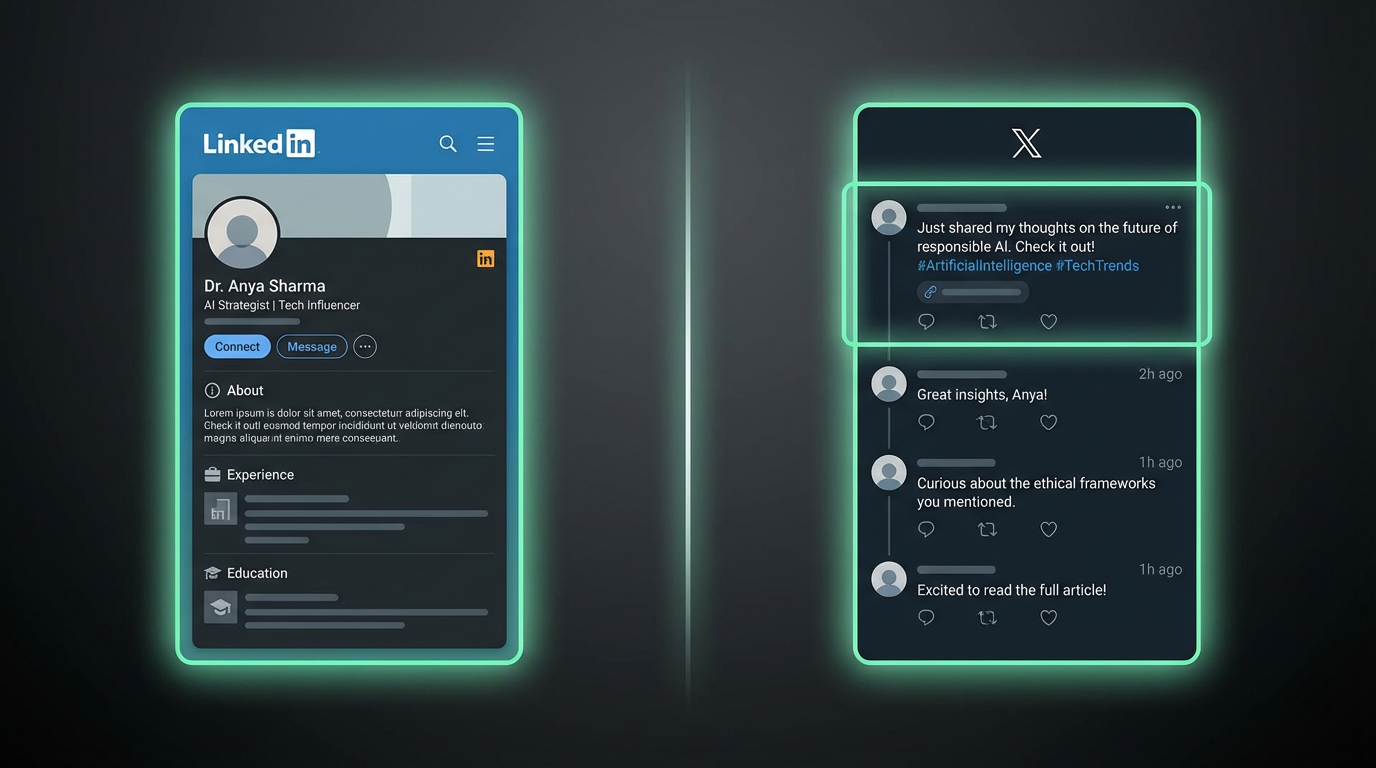
Not all social platforms are created equal. A post that performs well on LinkedIn might fall flat on X (formerly Twitter). Effective prompting requires tailoring your instructions to the unique audience and format of each platform. This is especially true for AI content prompts for LinkedIn, where professionalism and depth are valued.
Prompt 7: Create an Engaging LinkedIn Post
LinkedIn is the premier B2B network, where professionals expect value and insight. Data from the Pew Research Center (2023) shows its high adoption among university graduates and professionals, making it a critical channel.
Prompt: “Act as a B2B content expert for LinkedIn. Draft a post announcing our new report on ‘The State of UK SME Automation’. The post must be professional, around 150 words, and start with a hook that grabs the attention of a busy executive. Include 3 bullet points with surprising stats from the report. End with a question to drive engagement and include 5 relevant, niche hashtags.”
Prompt 8: Write a Series of X (Twitter) Threads
X requires brevity and a conversational flow. This prompt helps break down a complex idea into an engaging, multi-part thread. Notice how the prompt elements differ significantly from the LinkedIn one.
Prompt: “Create a 5-part X (Twitter) thread breaking down the key findings from our ‘State of UK SME Automation’ report. The tone should be punchy and direct. Each tweet must be under 280 characters. Start the first tweet with a bold claim. Use emojis sparingly to add visual breaks. The final tweet should link to the full report and ask a poll question.”
This platform-specific approach is vital as UK social media ad spending continues to grow, as Statista (2024) market data forecasts, making every post’s effectiveness more critical.
| Prompt Element | LinkedIn Approach | X (Twitter) Approach |
|---|---|---|
| Role | B2B Content Expert | Punchy Tech Commentator |
| Tone | Professional, authoritative, insightful | Direct, concise, conversational |
| Format | Single post, ~150 words, bullet points | 5-part thread, <280 characters each |
| Call-to-Action | Open-ended question for comments | Link to asset + poll question |
| Hashtags | 5 niche, professional hashtags | 2-3 broad, trending hashtags |
Advanced Strategic Prompts for Competitive Edge (Prompts 9-10)
Ready to move beyond content creation? These advanced prompts turn your AI tool into a strategic analyst, helping you spot opportunities and plan campaigns. This is where AI transitions from an assistant to a genuine partner in developing B2B social media content ideas.
Prompt 9: Conduct a Competitor Content Analysis
Understand what’s working for others in your space and, more importantly, what they’re missing.
Prompt: “Act as a competitive intelligence analyst. I will provide the social media handles for two of my main competitors. Analyse their last 15 posts on LinkedIn. Identify the top 3 content themes they focus on, their most common post format (e.g., video, text, link), and their typical tone of voice. Finally, identify one significant content gap or underserved topic that we could own.”
Prompt 10: Brainstorm a Multi-Channel Campaign
Use AI to sketch out a cohesive campaign that spans multiple platforms, ensuring your message is consistent and amplified.
Prompt: “Brainstorm a mini-campaign plan for the launch of our new software feature, ‘Automated Project Reporting’. The goal is to generate sign-ups for a webinar. Outline the campaign with: 1) A 3-part email sequence to our newsletter list. 2) 4 LinkedIn post ideas to run in the week before the webinar. 3) A title and outline for a supporting blog post. Ensure all content directs users to the webinar registration page.”
Beyond the Prompt: From Manual Work to Strategic Autopilot
These prompts are incredibly powerful. They can save hours and generate high-quality, on-brand content. However, there’s an honest admission we have to make: they still require you to be the ‘brains’ of the operation. You have to do the research, craft the prompts, copy-paste the output, schedule the posts, and analyse the results. For a busy SME leader, that’s still a significant time investment.
This manual effort is a major bottleneck. It’s the reason so many social media strategies fizzle out. What if you could automate the entire strategic process?
Case Study: How a UK firm saved 15+ hours weekly through AI
Challenge: A UK professional services firm was dealing with the ‘hidden cost’ of manual data entry and social media management, with senior staff wasting valuable billable hours on repetitive tasks.
Solution: They implemented a fully automated social media system that integrated brand profiles with automated workflows.
Results: The firm saved 15+ hours weekly, which were reallocated to client-facing activities.
Key Insight: AI automation can significantly reduce time spent on manual tasks, leading to substantial efficiency gains for professional services SMEs.
This is where we built Social Media HQ by Up-Stride to be different. We created a system that operates on our proprietary Auto-Run framework. Instead of you manually feeding prompts into a generic tool, our platform does it for you. It uses your locked brand profile to generate, schedule, and post content every single week. It’s a system that gets smarter every week, learning from performance data to refine its approach. It’s social media running on autopilot.
Frequently Asked Questions
What are AI prompts for B2B?
AI prompts for B2B are specific, detailed instructions given to an AI tool to generate marketing content tailored for a business-to-business audience. Unlike simple questions, effective prompts include context about the target audience, brand voice, desired format, and strategic goals. This level of detail is what separates generic, uninspired AI content from posts that truly resonate with a professional audience and drive business results.
How do you write a good B2B marketing prompt for AI?
A great B2B marketing prompt includes a clear role for the AI, a specific task, rich context, and defined constraints. We recommend assigning a role (e.g., ‘Act as a B2B marketing expert’), stating the task (‘Draft a LinkedIn post’), providing context on your audience and goals, and setting constraints on tone and format. This structured approach, which we call R-T-C-F-C, ensures the output is consistently relevant and on-brand.
Can ChatGPT create effective LinkedIn content?
Yes, tools like ChatGPT can create excellent LinkedIn content, but only with highly detailed and strategic prompts. Simply asking it to ‘write a LinkedIn post’ will yield generic results. To get effective content, your AI content prompts for LinkedIn must provide the AI with deep context on your target persona’s pain points, your professional brand voice, the desired post length, and a clear call-to-action to generate posts that foster genuine engagement.
What is an effective AI for B2B social media?
The ‘best’ AI depends entirely on your business needs and resources. For manual content creation, advanced models like GPT-4 are powerful co-pilots. However, for strategic automation that saves maximum time, a specialised platform like Social Media HQ is often a superior choice. It integrates brand-aware content creation with scheduling, analytics, and continuous learning, removing the manual work of prompting and posting altogether.
How can AI help with B2B lead generation on social media?
AI accelerates top-of-funnel content creation, which is crucial for attracting potential leads. It can analyse competitors to find content gaps, draft compelling thought leadership articles that build authority, and create engaging posts to promote lead magnets like whitepapers or webinars. By automating content production, AI frees up your team to focus on higher-value activities like engaging with prospects who comment on and share your posts.
Are AI-generated social media posts detectable?
With sophisticated prompts and a light human touch, AI-generated content can be virtually indistinguishable from human writing. While basic AI content can seem robotic, using a detailed brand voice prompt and a review-and-edit step ensures authenticity. The goal isn’t to hide the use of AI, but to use it as a powerful co-pilot to elevate your own ideas and maintain a genuine connection with your audience.
What are the limitations of using AI for social media content?
The primary limitations are a potential lack of authentic brand personality, the risk of factual inaccuracies (‘hallucinations’), and a limited grasp of real-time cultural nuance. AI models don’t have lived experiences or genuine emotions. This is why a human review layer is critical for fact-checking and adding a final touch of personality. Alternatively, a specialised, brand-aware system with built-in safeguards is a more reliable approach.
How do I maintain my brand voice when using AI?
You maintain your brand voice by creating and consistently using a detailed ‘brand voice and style guide’ prompt. This foundational prompt should act as a master instruction set for the AI. It needs to include details on your company’s tone (e.g., ‘formal and authoritative’), specific industry terminology to use, words to avoid, and even examples of your best-performing content for the AI to emulate.
What’s the difference between a B2B and B2C AI prompt?
The core difference lies in the audience’s motivation and the platform context. A B2B prompt typically focuses on professional pain points, efficiency, expertise, and Return on Investment (ROI), often designed for platforms like LinkedIn. In contrast, a B2C prompt is generally more emotional, focusing on lifestyle benefits, entertainment, and brand storytelling for visually-driven platforms like Instagram or TikTok.
How can I use AI for competitor analysis on social media?
You can give an AI a highly specific analytical task to gain strategic insights quickly. For example, you can prompt it: ‘Analyse the last 10 LinkedIn posts from Competitor X and Competitor Y. Identify their main content themes, posting frequency, and common calls-to-action. Then, suggest three content opportunities they are currently missing that are relevant to our target audience of UK finance directors.’
Important Considerations and AI Limitations
While AI offers immense potential, it’s crucial to acknowledge its limitations. Generative models can occasionally produce factual inaccuracies or ‘hallucinate’ information that sounds plausible but is incorrect. All AI-generated content, especially data points or specific claims, must be fact-checked by a human expert before publication. Also, AI can struggle with capturing the subtle nuances of a specific company culture or responding to hyper-current events with genuine empathy.
These prompts represent a powerful Do-It-Yourself (DIY) approach to content creation. Alternative strategies include hiring a specialised marketing agency or a freelance social media manager. While agencies may offer deep strategic expertise, they often come at a significant cost and require heavy management. The DIY method is cost-effective but extremely time-intensive, which, as the FSB research indicates, is a major barrier for many UK SMEs.
For businesses seeking to balance cost, time, and expertise, a hybrid approach is often best. Use AI as a powerful assistant but ensure a human is in control of strategy and final approval. If your team lacks the time to even manage the prompting and review process, it’s a strong signal to explore a fully automated system or consult with a marketing automation specialist to find a more scalable solution.
Your Next Step Towards Effortless Social Media Growth
Mastering strategic AI prompts for B2B is a significant step towards creating efficient, high-impact social media content. Moving beyond simple commands to a structured prompting framework allows you to guide AI to produce relevant, on-brand, and platform-specific posts. This expertise in AI prompt engineering for marketing UK can transform a generic tool into a valuable creative partner, saving time and sparking new ideas.
However, the ultimate efficiency lies in automating the entire workflow. The prompts in this guide are the ‘engine’, but you still need a system to drive the car. Our Social Media HQ platform provides that system with its Auto-Run functionality – it not only generates content but also builds, posts, and learns on autopilot, freeing you to focus on running your business. It’s designed so you can set it up once and let it run forever. No ongoing effort. No agency.
Start your free 7-day trial to experience what a fully automated social media system can do for you.
References
- Federation of Small Businesses (FSB) – 2023 Report. A survey of UK small businesses found that 25% identify a lack of time as a key challenge in adopting new technologies.
- Stanford University Human-Centered AI (HAI) – 2024 Annual Report. The AI Index Report tracks the accelerating capabilities and economic impact of generative AI models across various global sectors.
- UK Government – National Strategy Document. This document outlines the UK’s 10-year plan to support the transition to an AI-enabled economy and encourage AI adoption by SMEs.
- Pew Research Center – 2023 Fact Sheet. This demographic research on social media usage shows LinkedIn’s high adoption rate among professionals and individuals with higher education.
- Statista – 2024 Market Data. Analysis and forecasts project that social media advertising spending in the United Kingdom will continue to grow significantly, reaching new highs in the coming years.
Conclusion
Your Next Step Towards Effortless Social Media Growth
In summary, AI prompts for B2B are a significant step towards creating efficient, high-impact social media content. Moving beyond simple commands to a structured prompting framework allows you to guide AI to produce relevant, on-brand, and platform-specific posts. This expertise in AI prompt eng